-->

Monday, 30 April 2007

Short's classic king march

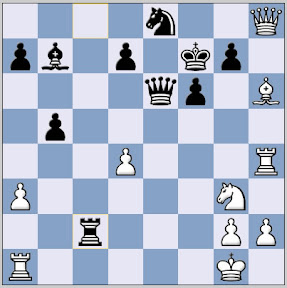
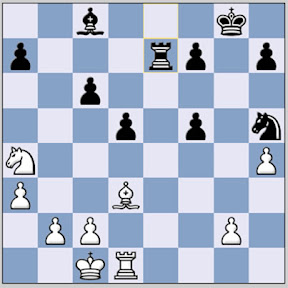
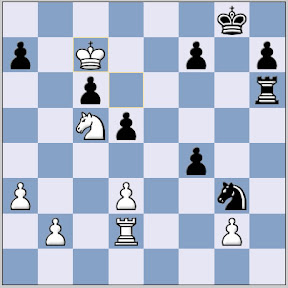
Last week, I posted an inspired king march by Mikhail Tal. Today's game shows Nigel Short launching an incredible attack with his king in the midst of a ferocious middlegame battle with Jan Timman.

Here's what Nigel had to say to Chess Tales about this modern classic:

"I think I could have won with Nh4! (threatening Nxg6! and Rh4 at some moment) I didn't see it at all at the time: I think it was pointed out by Krasenkow (or maybe even his wife) later. Actually I was in quite a bit of time trouble. And yes, I did see the idea of K to h6 when I played Kh2.", Nigel Short

Nigel Short - Jan Timman, Tilburg 1991


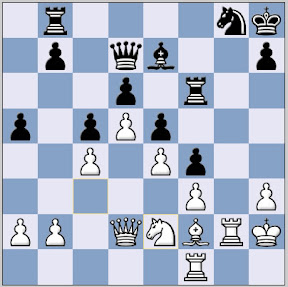
1.e4 Nf6 2.e5 Nd5 3.d4 d6 4.Nf3 g6 5.Bc4 Nb6 6.Bb3 Bg7 7.Qe2 Nc6 8.O-O O-O 9.h3 a5 10.a4 dxe5 11.dxe5 Nd4 12.Nxd4 Qxd4 13.Re1 e6 14.Nd2 Nd5 15.Nf3 Qc5 16.Qe4 Qb4 17.Bc4 Nb6 18.b3 Nxc4 19.bxc4 Re8 20.Rd1 Qc5 21.Qh4 b6 22.Be3 Qc6 23.Bh6 Bh8 24.Rd8 Bb7 25.Rad1 Bg7 26.R8d7 Rf8 27.Bxg7 Kxg7 28.R1d4 Rae8 29.Qf6+ Kg8


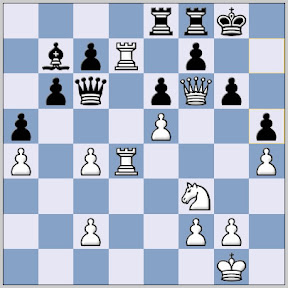
This is where Nh4! would have been strong.


30.h4 h5


Short vs Timman Tilburg Chess 1991

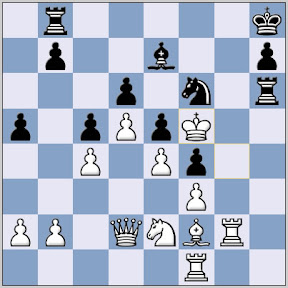
And now Nigel treated us to his incredible king march:


31.Kh2!! Rc8 32.Kg3 Rce8 33.Kf4 Bc8 34.Kg5 1-0

100 Not Out

Chess Tales reached a milestone today: it's 100th post. There's been some smooth shots, a few streaky outside edges and the occasional 'hoick' to cow corner, but that's 100 Not Out in just less than 2 months. (I'd prepared a whole post of cricketing analogies, but I'll stop there).

I started the blog as part experiment / part get a few stories off my chest; the way it's taken off has been fantastic.

I've had the opportunity to chat with some of the superstars of the game, but the most rewarding thing has been feedback from the regular readers all over the world: I hope we stay friends for a long long while.

Ok, I'm off to the attic to discover some more 'lost' chess gems.

Bumping into Nigel Short

How often does Nigel Short ask you for advice on playing Kasparov?

That's what happened on Friday to Chess Tales. Ok, it was a 'tongue in cheek' request, but it was the real Nigel Short.

"I could do with some tips on playing Kasparov. Can you give me some advice?" Nigel Short

I'd posted a response on a MySpace forum about chess improvement, suggesting they checked out our Saturday tips on Chess Tales, when Nigel appeared asking for help. A couple of emails later, I had a new 'friend' on MySpace and a couple of comments from one of the truly great chess players to use on Chess Tales (Stay tuned).


Check out Nigel's fledgling MySpace blog for details of his globetrotting playing itinerary.


(p.s. My work, when I'm not playing chess or writing about it, involves helping businesses prepare for the future; I'm particularly interested in the Internet (Web2.0), Social Networks (like MySpace), Blogging and all that. You can check out one of my recent presentations.)

Saturday, 28 April 2007

Definitive list of 'must-have' chess books

Here it is, the definitive list of the 'must-have' chess books.

A couple of weeks ago, Ryan Emmett asked me to produce a list of the best books for an aspiring club player. This task was way way harder than I first imagined, and has also made me realise I have some 'catch-up' reading to do.

I've broken it down into 4 categories, picked 2 books from each, but also listed some other worthy contenders. You'll notice there are no openings books, but only because the best ones depend on which openings you like to play. Reuben Fine's "The Ideas Behind the Chess Openings" nearly made it onto the list as a general guide, but apparently many of the variations are now too dated. As a general rule for openings books, avoid the reference manuals with variation upon variation and concentrate on the strategic concepts / key games / repertoire style books.


Endgames

  1. "Chess Endings: Essential Knowledge" by Yuri Averbakh
  2. "Endgame Strategy" by Mikhail Shereshevsky

Averbakh's handbook covers all the basic endgame theory that every chess player should know (and it's amazing how many don't); essential... yes! For a guide to strategic endgame concepts and practical play then Shereshevsky is your man.

Going further: Dvoretsky's "Dvoretsky's Endgame Manual", harder work, but the next step after you've mastered Averbakh's book. For a deep insight into endgames arising from specific openings, and for a general improvement in your chess planning and understanding, "Mastering the Endgame (Volumes 1&2)" again by Shereshevsky are wonderful books. Finally, for an endgame reference work there is Keres' classic "Practical Chess Endings".

Middlegame / Strategy

  1. "How to Reassess Your Chess" by Jeremy Silman
  2. "The Art of the Middle Game" by Paul Keres and Alexander Kotov

This was the most difficult category, as I've read few of the great middlegame books. Both of the chosen works were recommended to me, and receive exceptional reviews.

Two books I have read that came close are the legendary "Think Like a Grandmaster" by Alexander Kotov (I'm somewhat sceptical on the first chapters about analysis, but the book remains fantastic) and Dvoretsky's "Secrets of Chess Tactics" (which is only kept off the list because I suspect it's best suited for 2200+ players rather than improving club players). In fact any of the Dvoretsky books could be in this list; I suggest looking out for the revised Olms versions as they appear this year, or picking up cheap used copies of the older works.

Other middlegame classics to consider are "Pawn Power in Chess" by Hans Kmoch, "Modern Chess Strategy" by Ludek Pachman, "Manual of Chess" by Emmanuel Lasker, and "Simple Chess" by Michael Stean. "From Beginner to Expert in 40 Lessons" by Alexander Kosteyev also deserves mention.

Games Collections

  1. "Zurich International Chess Tournament 1953" by David Bronstein
  2. "Understanding Chess Move by Move" by John Nunn

Bronstein's work on the 1953 Candidates tournament was the first book on to my list, and if you are only allowed one book on a desert island, this is the one to take. Thirty rounds of chess between fifteen fabulous players including 3 World Champions, inspiring analysis, arguably the dawning of the new 'modern age' in chess. Nunn's work could equally have gone into the strategy category, a deep but readable study of 30+ of the best games played in the 90's (excellent for studying the classic games, see yesterday's improvement tip).

There are many contenders: Timman's "Art of Chess Analysis" is similar to Nunn but covers great games from the 70's'; Chernev's "The Most Instructive Games of Chess Ever Played" is a fabulous collection of well-chosen games, but I found the annotations annoying. Of course, Fischer's "My 60 Memorable Games" remains a 'must-have' book, but I'd be more tempted by Kasparov's five volume series on "My Great Predecessors" (start with part 5 on Korchnoi and Karpov). Interestingly, what is missing is a book of Kasparov's games by Kasparov.

The 'And Because' Category

Whilst the above books will all help your chess, this final category of books are in because I think it's important to know about the history of the game, in particular the Cold War politics, indoctrinated mindsets and repression that chess has been instrincally linked to:

  1. "Chess Is My Life" by Viktor Korchnoi
  2. "Fischer Versus Spassky: Chess Match of the Century" by Svetozar Gligoric

Also "Karpov - Korchnoi 1978" by Keene covers a fascinating match; "The Soviet School of Chess" by Kotov and Yudovich is incredible propaganda; Nimzovich's "Karpov - Korchnoi 1978" is wonderful from a historical point of view. Happy reading!

On Amazon: Chess Tales 'Must-Have' Books

I'm conscious the list is missing a pure tactics book (find the winning combination); any suggestions from Chess Tales readers welcome.

Friday, 27 April 2007

Chess Improvement 4: Studying the classics

Studying classic chess games is something that the former Soviet players and chess schools placed great emphasis on. It's certainly something you should be considering as part of your chess improvement programme.

chess improvement programmeStudying the games from the great players serves many purposes: you will learn more strategic plans; better understand how to recognise and exploit positional strengths and weaknesses; improve your pattern recognition and ability to form suitable plans; and have greater awareness of tactical opportunities.

My advice is to adopt the approach suggested by Dvoretsky (in Secrets of Chess Training): play through the opening, and then cover up one side's moves and try to guess them, spending at least 45 minutes on studying each game.

You will need the games available in a format that lets you cover up moves easily, and preferably you will want games that have been well annotated. We'll look at making a set of games available via Chess Tales in a suitable format.

Which games should you study? Dvoretsky and Kotov (in Think Like a Grandmaster) suggest beginning with Rubinstein (a master strategist and endgame player) and then moving on to Alekhine and Capablanca. Along with these 3, I suggest working back through the World Champions: Kasparov, Karpov, Fischer, etc.. An alternative is to get a well chosen list of games that has already been prepared, for example Nunn's Understanding Chess Move by Move.

Obviously time will determine how many games you can study, but even just one game per week would see you absorb 52 wonderful games of chess and new ideas by the end of a year.

Studying games like this will also have the side effect of helping you, as Kasparov recommends, to continually broaden and deepen your opening repertoire.

Chess Tales biased?

I've received some correspondence recently suggesting that Chess Tales is biased, that we lean to the left, or as they put it: we are all about 'b****y' d4 openings.

So, embracing the 21st paradigms of Open Innovation and Crowdsourcing, it would be great to hear from the Chess Tales readers:

Which chess openings would you like to see reviewed (strategic ideas, interesting lines, and famous games)?

Friday chess puzzle 3

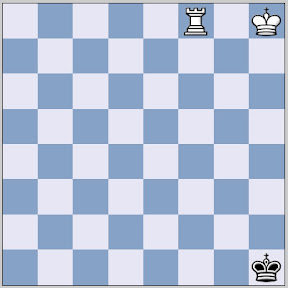
Today's puzzle is White to play and it looks trivial, but there is a catch: you are only allowed to move your rook once:


The question:

Can White play any king move and still win? Or, has White only got one move that wins in this position? Is so, show me the winning line and how Black draws against the other moves.


Email me on roger AT 21thoughts DOT com. Answers on Wednesday.

Thanks again to Paul Dargan for showing me this position

Thursday, 26 April 2007

Nimzo Indian Sämisch Variation

Few openings are as direct and uncompromising as the Sämisch Variation of the Nimzo Indian, after

1 d4 Nf6; 2 c4 e6; 3 Nc3 Bb4; 4 a3 Bxc3+; 5 bc

White essentially has one idea in mind: I'm going to blast open lines for my rooks and diagonals for my bishops, and checkmate you on the king-side. White often carries out this plan at any cost.

Strategically, it's easy to learn and I've enjoyed playing it; Such direct attacking has notched me some notable scalps. Of course, there is a downside, a well organised defence can expose the lack of flexibility and positional weaknesses (notably the c4 pawn) in White's position.

Over the coming weeks, I'll show you a few games in this line (wins for both Black and White) and some of my own personal favourites. To start with though, let's go back to Zurich 1953, and the second round encounter between Efim Geller and former World Champion Dr. Max Euwe. This game was awarded a brilliancy prize. The notes are abridged from David Bronstein's in his excellent book of the tournament:

Geller - Euwe, Zurich 1953

White initiates a powerful attack on the king by sacrificing his c4-pawn. This attack gave Geller every hope of success, provided Black held to the traditional sort of queen-side counterattack. Euwe, however, carried out two remarkable ideas: 1. Utilizing his queen-side lines of communication for an attack on the king's wing. 2. decoying the enemy's forces deep into his own rear area, with the aim of cutting them off from the defence of their king.

Watch White's pieces in their frontal assault on the king, burrowing further and further, while Black is transferring his forces by roundabout routes.

1 d4 Nf6; 2 c4 e6; 3 Nc3 Bb4; 4 e3 c5; 5 a3 Bxc3+; 6 bc b6; 7 Bd3 Bb7; 8 f3 Nc6; 9 Ne2 0-0; 10 0-0 Na5; 11 e4 Ne8

Black retreats his knight to forestall the pin with 12 Bg5, and to be able to answer f3-f4 with f7-f5, blockading the king's wing. White therefore secures f5 before advancing his f-pawn. It would be senseless to defend the c4 pawn now: that pawn was doomed by White's 5th move.

12 Ng3 cd; 13 cd Rc8; 14 f4 Nxc4; 15 f5 f6; 16 Rf4

White's attack has become rather threatening. Black's previous move was necessary to forestall White's intention to push his pawn to f6, and then, after 16 ... Nxf6, to the pin the knight after all, piling up on the king with the combined firepower of queen, rooks and three minor pieces. Even now, White needs only two moves to transfer his rook and queen to the h-file, and then it might appear that nothing could save the Black king. (it's a wonderful feeling as White to be able to 'thump-down' f5-f6 in this variation, we'll see some games later where this happens - RC)

16 ... b5!

The beginning of a remarkable plan. Clearly, any defensive manouevres on the king-side are fore-doomed, since they involve pieces with an inconsequential radius of activity (.. Rf7, .. Qe7, etc.). But Black does have another defensive resource, and that is counterattack! The bishop at b7, the rook at c8, and the knight at c4 are all well based; all that remains is to bring up the queen. The basis for this counteratack is Black's preponderance on the central squares. With 16 ... b5, Black reinforces the knight on c4 and opens a path for the queen to b6. Still, one cannot help feeling that his operations are too little and too late...

17 Rh4 Qb6

Pinning White's queen to the defence of the d-pawn, Black prevents the intended 18 Qh5. After 17 Qh5 Qb6; 18 Ne2 Ne5, we get the echo variation with the rook unable to get to h4.

18 e5 Nxe5; 19 fe Nxd3; 20 Qxd3 Qxe6; 21 Qxh7+ Kf7; 22 Bh6 Rh8

If Black's 16th move was the beginning of his strategic plan of counterattack, then this rook sacrifice is it's fundamental tactical stroke, with the aim of drawing the White queen still further afield and decoying it from the c2, meanwhile attacking the king.

23 Qxh8 Rc2

Threatening mates in a few moves: 24 ... Rxg2+, 25 ... Qc4+, etc. Detailed analysis requiring more than just one week's time, showed that White could have saved himself from mate by finding a few 'only' and very difficult moves. First, he has to play 24 d5; if then 24 ... Qb6+; 25 Kh1 Qf2; 26 Rg1 Bxd5, White saves himself with 27 Re4!; and on the immediate 24 ... Bxd5, not 25 Rd4 - only 25 Rd1! works: after 25 ... Rxg2+; 26 Kf1 gh, neither 27 Rxh6 nor 27 Rxd5: once again, the only move is 27 Qxh6. Black would still have bishop and two pawns for his rook then, which would leave him good winning chances.

24 Rc1 Rxg2+; 25 Kf1 Qb3; 26 Ke1 Qf3 0-1


Wednesday, 25 April 2007

Grünfeld Defence in Argentina

I was contacted online today by one of the authors of the Argentinian chess blog "Solo Ajedrez". The power of social networking software!

They have a team of high calibre players that includes International and FIDE Masters. They tell me their mission is to engage with their readers in an easy form and to avoid conventionality. The site is well worth a visit if you speak Spanish.

I've written a couple of times about the Grünfeld Defence, and was interested to see that it has also been covered recently in a class on Solo Ajedrez. They look at an energetic Black riposte to a sideline that has been tried by Korchnoi amongst others (1 d4 Nf6; 2 c4 g6; 3 Nc3 d5; 4 cd Nxd5; 5 Na4!? e5!?).

Grandmaster Preparation, the first ever chess blog

Grandmaster Preparation by Lyev Polugayevsky is an unusual but captivating chess book; browsing through it yesterday, I couldn't help but notice how much like a blog it feels.

The book is neither a middlegame manual, nor an openings primer, nor a games collection, nor is it a biography. Yet, at the same time, it contains elements of all these. What sets it apart and makes it feel like blog is the personal nature of the narrative: Polugayevsky talks about his thoughts, his emotions, what he was doing during the hours before key games, and his giving birth to and raising his child (a new and highly risky variation in the Sicilian Defence). Much of the material, presented chronologically, reads like the pages of a diary and further cements the blog like nature of the work.

The book starts with a discussion during a walk with Botvinnik, moves on to the Polugayevsky variation in the Najdorf, and finishes with chapters called "In the interval" and "On the eve", where Polugayevsky discusses interesting adjournments, and then games that were important to him, including meetings with Tal, Karpov, Fischer and Spassky amongst others. The chess annotations are very good; the narrative and insights are fascinating.

It's now out of print, but you can source second hand copies via Amazon: Grandmaster Preparation (Pergamon Russian Chess)

Friday chess puzzle #2: solution

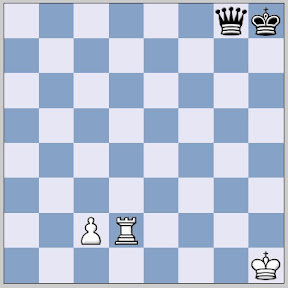
I was surprised how quickly some of you solved last week's Friday puzzle from Asztalos vs Ban, Budapest 1956:

Asztalos vs Ban, Budapest 1956, Chess Tales Friday Puzzle

Obviously White can win Black's queen for his rook, but to win the game he also needs to get his king to the fourth rank first. So, the solution is:

1 Rh2+

Now:

1 ... Kg7; 2 Rg2+ Kany; 3 Rxg8 Kxg8; 4 Kg2 and the king reaches c4 with a straightforward win (see Chess Improvement #3: Your endgame databank).

But, Black has a clever defensive try:

1 ... Qh7;

Now:

2 Qxh7+ would be a mistake, as after 2 ... Kxh7, the Black king reaches c5 with the opposition, i.e. 3 Kg2 Kg6; 4 Kf3 Kf5; 5 Ke3 Ke5; 6 Kd3 Kd5; 7 Kc3 Kc5 with a standard drawn position

However, White can still win: 2 Kg2! and again the White king gets to c4 with a straightforward win: e.g. 2 ... Qxh2+; 3 Kxh2 Kg7; 3 Kg3 Kf6; 4 Kf4 Ke6; 5 Ke4 etc. or 2 ... Kg7; 3 Rxh7+ Kxh7; 3 Kf3

Stay tuned for this Friday's puzzle.

Tuesday, 24 April 2007

Marching the King

A King marching up a crowded chess board is a rare sight, but almost always the sign of a spectacular game. Most often, it is because the King has been driven up the board by the attacking pieces to be lured into a mating net, but occasionally the march is voluntary.

In this post, I've got an illustration of both. They are from two of the best games in chess history. The first sees Mikhail Tal strolling up the board, sacrificing two pawns in the process, to set up a winning ending. The second is a spectacular king hunt by Alexander Kotov; the most beautiful game played at the famous Zurich 1953 Candidates Tournament.

Tal vs Lissitzin, Instructive ChessThis is the postion after 24 moves in Tal vs. Lisitsin, Leningrad 1956 (Game no.2 in Chernev's "The Most Instructive Games of Chess Ever Played"). Tal has sacrificed a pawn to hem in Black's bishop and break up the kingside pawn structure, but Black is not without compensation: his rook is on the open file, his knight is preparing to invade and White's kingside pawns are potentially vulnerable. Tal, though, hit on an inspired idea to exploit Black's weaknesses: he marched his king up the board:

25 Kd2! Ng3; 26 Kc3 f4; 27 Kd4 Bf5; 28 Rd2 Re6; 29 Nc5 Rh6; 30 Ke5! Bxd3; 31 cd Rxh3; 32 Kd6 Rh3+; 33 Kc7

Tal vs Lissitzin, Instructive ChessIn just 8 moves Tal's king has gone from c1-c7 and he has sacrificed a second pawn. However, he now uses the active position of his king to force a won rook ending:

33 ... Nf5; 34 Kb7 Nd4; 35 Rf2 a5; 36 Rxf5 Ne6; 37 Rg4+ Kf8; 38 Kxc6 Nxc5+; 39 Kxc5 Re6; 40 Kxd5

Tal is clearly better in this rook ending; it's instructive to follow his technique in concluding the game:

40 ... Rb6; 41 b4 ab; 42 ab Ke7; 43 Kc5 Rf6; 44 Rd4 Rf5+; 45 Kb6 Rf6+; 46 Kc7 Rf5; 47 Re4+ Kf6; 48 Kc6 Rf2; 49 g4 h5; 50 gh Kg5; 51 b5 f5; 52 Rb4 f4; 53 b6 f3; 54 b7 1-0

The next game, Averbakh - Kotov Zurich 1953 was greeted with quotes such as "unique in chess literature" and "once in a hundred years". This is what Bronstein had to say about the position after White's 30th move:

Averbakh - Kotov, Zurich 1953 Candidates Chess Tournament

"The creative element of chess is generally thought to consist of three things: logic, accurate calculation, and technuique (this last includes a knowledge of theory). There is a fourth ingredient also, however, perhaps the most intriguing of all, although it is often overlooked. I refer to intuition - chess fantasy, if you prefer.

Occasionally a position arises in the course of a game which cannot be evaluated on general principles, such as pawn weaknesses, open lines, better development, etc., since the state of equilibrium has been upset on several counts, rendering an exact weighing of the elements impossible. Attempting to calculate the variations doesn't always work, either. Imagine that White has six or seven different continuations, and Black five or six replies to each move; it's easy to see that no genius on earth could reach even the fourth move in his calculations. It is then that intuition or fantasy comes to the rescue: that's what has given the art of ches its most beautiful combinations, and allowed chessplayers the chance to experience the joy of creating.

It is not true to say that intuitive games were only played in the days of Morphy, Anderssen and Chigorin (as if now, in our era, everything were to be based totally on positional principles and rigorous calculation!): I remain convinced that, even in the games which received the brilliancy prizes at this tournament, not all of the variations were calculated to the end. Intuition has been and remains one of the cornerstones of chess creativity - of which we shall now see proof positive." David Bronstein, International Chess Tournament: Zurich 1953

Kotov began a remarkable combination by sacrificing his queen:

30 ... Qxh3+; 31 Kxh3 Rh6+; 32 Kg4 Nf6+; 33 Kf5

Averbakh - Kotov, Zurich 1953 Candidates Chess TournamentThe king has been driven into the net of Black's remaining pieces, and now 33 ... Ng4! would have finished the game quickly. Although, after the move Kotov played, 33 ... Nd7, White despite his extra Queen was still unable to defend the position.

You can play through the full games Tal vs Lisitsin and Averbakh vs Kotov online.

Monday, 23 April 2007

How much time do you spend playing chess?

I got an email over the weekend from a Chess Tales' reader in Pune, India. Prashant, a medical student, asked "how much time do I spend playing chess, and against whom?"

I'm sharing it with you because, I thought it would be a great question to put to all you Chess Tales readers.

I tend to 'keep my eye in' by playing on the Internet; I use a couple of sites: Buho21 and more often nowadays on Chess Assistant. Both are free to join, check out my previous post about them. Buho21 is also a great place to practice my Spanish, unfortunately I don't have any Russian to use on Chess Assistant.

I only play blitz chess online (between 1 minute and 3 minutes each / game); it seems crazy, but I don't have the patience for anything longer in cyberspace. I had a spell where I was playing a tournament or two everyday online (and probably about 1-2 hours / day), but due to commitments of starting a new company (and writing a blog!) I've not been a regular visitor recently. You can check me out on either site under the handle 'rogercoathup'; please say "hi" and challenge me to a game.

I also play league chess (3 hour long games) for Tynemouth, where I captain one of the teams. I don't find time to get to many club nights though. Other than that, it's tournaments (usually 3 or 4 weekend swisses each year and the county championship). Looking ahead, I'm planning an International tournament in the summer, and a better organised training schedule in preparation. If that goes well, I'd like focus my energy on these higher level events.

Prashant explained that he gets to spend about 2 hours / day playing, and that is against Fritz or ChessMaster on a handeld.

I don't play against computers myself, but do use them when I'm analysing / playing through a game: an early version of the Fritz engine in ChessBase on my PC, or Hi-arcs / Sigma on my Mac. Buho21 used to have a free engine called Sherlock, but it's no longer available.

The handheld is interesting, I saw someone running Fritz on one the other night; she was analysing my game (against her father) whilst we played. In this case it was innocent, but I guess highlights how they could be used surreptitiously.

So what about you guys? Where do you play and how often? How much time do you spend studying game? And, perhaps more interestingly, how much time would you like to spend studying chess?

Sunday, 22 April 2007

More European Chess Championship photos

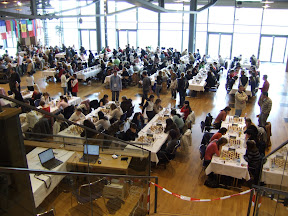
The Women's section at the European Chess Championships:

Women's Boards, European Chess Championships


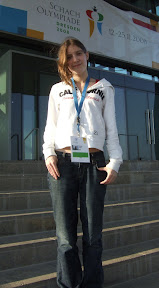
Sophie Seeber outside the venue:

Sophie Seeber, European Chess Championships


Pictures by Martin Seeber

Resources for chess news

I'd been planning to post about the best resources on the web for chess news, but instead will just point you to Mark Weeks, who has compiled an excellent and well annotated list on About, "Elsewhere on the web: resources for chess news".

We like Mark at Chess Tales, and not only because we are in his list of the top 21 chess blogs!

Thinking chess books

One of the Chess Tales' readers has asked me if I could recommend a list of "must-have" chess books. I've started thinking hard, but believe me it's not easy. For example, opening books pre-dominate in chess literature, but with so many openings out there, and everybody having their own favourites, it's difficult to make general recommendations. I've set myself a target though: a top 10 by next Sunday. Keep watching this space!

In the meantime, let me talk about a book that came out recently and has been fighting Kasparov's "Life Imitates Chess" toe-to-toe for the review column inches: "The King's of New York" by Michael Weinreb.

This is not your usual chess book, but more a chronicle of the lives, relationships, and ups and downs of a 'wrong side of the tracks' but highly successful school chess team. Edward R Murrow school is in Brooklyn, New York and draws its students from a diverse range of cultures; the chess team, coached by a former hockey professional, includes a Lithuanian and a Puerto Rican amongst others.

I have to admit I haven't read the book, but it would great to hear the thoughts of any Chess Tales' reader who has. Email me on roger AT 21thoughts DOT com.

You can also check out what the newspapers have been saying about the book, whose subtitle is "A year among the geeks, oddballs and geniuses who make up America's top high school chess team":

"Geeks, oddballs and geniuses", Daily Telegraph (UK) 19th April

"Mad hot chessboard", NY Times (US) 4th March

"Chess with God (and others)", The Guardian (UK) 21st April

"He was more fun in the pawn squad", The Guardian (UK) 22nd April

Saturday, 21 April 2007

Chess improvement #3: Your endgame databank


If you want to succeed at Chess, it's crucial to know how to play fundamental endgames, how to convert those final positions and get valuable points on the tournament board. Equally important, a knowledge of fundamental endings will help you earlier in the game, enabling you to spot opportunities to simplify into positions you know are won, or to create drawing chances when all seems lost.

Kasparov referred to this as "investing in your own bank of endgames": the more endgames you know, the more points you will chalk up on the tournament board. This advice is applicable to all players from beginner to World Champion. The number and complexity of the endgames might increase, but the basic principle holds fast.

In this article, I'll introduce you to some of the 'basic' endings, those that I think it is essential for a novice to learn, and that a club player should know (it's amazing how many don't, even very good ones). I'm going to assume that you know how to checkmate with K+Q vs. K, K+R vs. K, K+2B vs. K; if you don't, then make that your starting point instead (see the book recommendations later).

I won't give variations, instead consider it a checklist of positions to test yourself against. If you need advice for any of these positions, post a comment and I'll happily show you the best continuations. Alternatively, look them up in your endgame book; if you don't have one, it might be time to invest. I'll recommend some at the end of the article.

King and Pawn vs. King
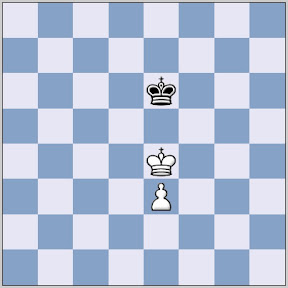


Is this a win or draw for White? Well, the answer depends on whose move it is. Can you play it out with both Black or White to play, and know how it finishes with best play? This is the first ending any chess player should learn and essential to master; consult your endgame book, learn it and also about the concept of "the opposition".

To some of you, this may seem trivial, but here's how Scotland's top woman player at an Olympiad handled it:
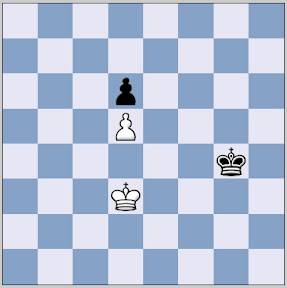


Seeing that she was going to lose her pawn on d5, she incredibly resigned! Of course, the position is completely drawn: she simply has to ensure that she meets Kxd5 with Kd3 gaining the opposition and drawing.

If the pawn is a rook pawn, then the ending is almost always drawn. Again check your endgame book to discover the additional drawing resources.

By knowing these basic positions you can make much more informed decisions when determining the best continuation earlier in the game.

King, Rook and Pawn vs. King and Rook
Rook endings are the most frequently encountered ending. They are full of complexities and subtleties that would take several lifetimes to master. A rule of thumb is "the active continuation is usually better than the passive continuation", and as for basic endings, there are two that are essential to know how to play.

The first is how to win this position:
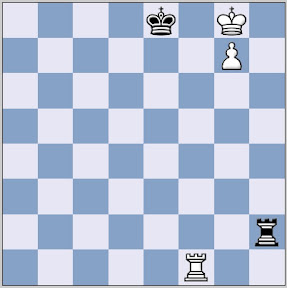


The solution was first published by Lucena over 500 years ago, and involves the concept of "building a bridge"

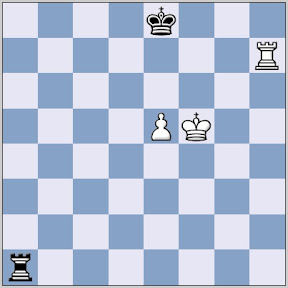
And the second is how to draw this position, first published by Philidor in 1777:


Other essential endings
Do you know how to play King and Queen vs. King and Pawn on the 7th rank? I used it to good effect in the second round at the recent Edinburgh Chess Congress, sacrificing an extra pawn in order to win the race to Queen and reach this won ending (with Black to move):
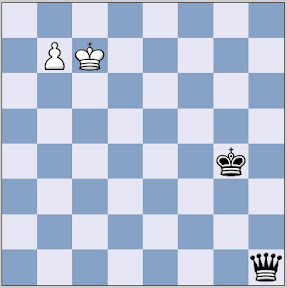


Knowing this position was won was essential to being able to determine the winning continuation earlier in the game. I was amazed that my opponent, a strong and rapidly improving junior (around 1800 rated), didn't know this ending and questioned me afterwards about whether he could have drawn the position. Do you know how to win from here?

It's also essential to know that this ending with a Rook Pawn or Bishop Pawn is not winning (unless your King is very close). Do you know the defensive resource that gains the draw with the Bishop Pawn?

The final ending I want to show is the Bishop and Rook Pawn of the wrong colour:
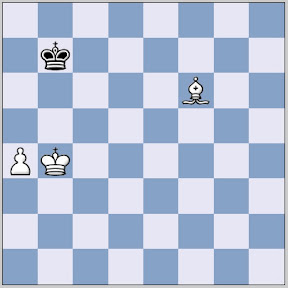


Despite the extra material, White cannot win this position. Black simply moves his King between a8 and b7 and the best White can do is deliver a draw by stalemate. Play it out if you are not familiar with this ending.

Knowledge of Bishop and Rook Pawn of the wrong colour has saved me many half points on the tournament table, by directing games into the ending, e.g. by exchanging off more dangerous pawns.

My concluding advice is:

  1. Build your 'endgame databank' by learning these basic endings (and how to recognise a won, drawn or lost position)
  2. Whatever your strength, work to keep expanding your 'databank' by learning further endings

And the book recommendations:

Averbakh's Chess Endings Essential Knowledge is definitely the place to begin; a guide to handling all the fundamental endings I've discussed and many more.

For endgame reference and some training, then
Practical Chess Endings by Paul Keres remains the best.

And finally, for the strong player looking to improve, you might want to give serious consideration to Dvoretsky's Endgame Manual.

Sophie and the World Champion

Sophie Seeber, Mariam Danelia, European Chess Championships
This is Sophie Seeber preparing for her round 3 game at the European Chess Championships. Her opponent is Mariam Danelia, the World U12 Chess Champion.

Thanks to Peter Sowray for the picture.

Posted by Picasa

Friday, 20 April 2007

The battle of Chess Tales

We battled to the wire tonight, but my pressure in the ending eventually told when Martin short of time missed the chance to draw.

The team won 4-0; so we are through to the next round of the knockout.

Gloves off at Chess Tales

It's "gloves off" today in the Chess Tales Studio:

Tonight my team (Tynemouth) are taking on Forest Hall in the first round of the summer chess knockout, and top board for the opposition will be fellow Chess Tales' contributor Martin Seeber.

Wish us both luck, and a fair fight with no biting, gouging or punches below the belt.

Friday chess puzzle #2: Asztalos-Ban

This week's chess puzzle is from Asztalos vs Ban, Budapest 1956.

Asztalos vs Ban, Budapest 1956, Chess Tales Friday Puzzle


It's White to play and the question is: with best play is this position won, drawn or lost? And, give me the first 3 moves of your solution.

Answers by email to Roger AT 21Thoughts DOT com (solution will appear on Wednesday)

I sourced the position from 1960 book: "The Delights of Chess" by Assiac. Assiac was the name of Heinrich Fraenkel's long running chess column in the New Statesman. The book brings together and expands on all of his best columns, and includes such intriguing chapter titles as "Is this proper Marxism?" and "Dostoyevsky has nothing to do with it". The New Statesman is the same journal that Tony Miles wrote for.

Thursday, 19 April 2007

Chess on the big screen: Queen of Cactus Cove

Queen of Cactus Cove
Queen of Cactus Cove is an award-winning short movie about Billie, a girl with aspirations to be a national chess champion. Their chess adviser certainly knows the game better than most; check out the King's Indian vs. King's Gambit cracks, the pain of a bad loss, and some 'true-ish to life' chess and tournament sequences.

It came out last year and has mainly been shown on the festival circuit. The full movie (22 minutes) is now available to watch online at the Independent Film Channel's Media Lab.

From the sublime to the ridiculous next. I suspect many of you will have already have encountered the hilariously awful "Chess Now", which apparently airs on Manhattan Neighbourhood Network TV. For those who haven't, here's episode 1 (warning contains some offensive material). YouTube has 3 more episodes and an interview with the 'brains' behind the show.

Thursday teaser #2: sex is like chess

The latest episode of which TV show featured the quote:

"Sex is like chess; when you are playing with an inferior competitor your game suffers"

Answers on a postcard to the usual address.

Pasadena 1983: Going, going, gone

Pasadena

My first "Chess in the Attic" post talked about the Korchnoi - Kasparov Candidates semi final match in London in 1983; Garry's most difficult hurdle (with the exception of Karpov himself) en route to the World crown.

Originally the match had been scheduled to take place in Pasadena (California), but to the surprise of most of the chess world was cancelled at the last minute. Jack le Moine has posted an interesting article from Stephen Jones on the behind the scenes shenanigans in Pasadena, how a group of 4 chess enthusiasts nearly lost an awful lot of money, underhand organisations (not FIDE this time!), and the difficulty in getting corporate and TV interest in chess.

Wednesday, 18 April 2007

Friday chess puzzle #1: the solution

Capablanca vs Lasker Blitz Game

The solution to last Friday's chess puzzle.

Capablanca 'played': 1 Ra8+!

after 1 ... Kxa8; 2 Kxc7, White wins the pawn on b6 and queens his own pawn.

and if 1 ... Nxa8; 2 Kc8 and Lasker only has one legal move 2 ... Nc7 allowing 3 Kxc7 and we have the same winning position that follows 1 ... Kxa8.

A delightful collection of themes from such a simple position.

Congratulations to those who got it right, and thanks to Paul Dargan for showing me the position.

The Grünfeld Defence 2

Ernst Grunfeld, Chess Player

I posted earlier this month about the Grünfeld Defence, but given it's high popularity in Google searches that are used to discover the Chess Tales blog, I'm happy to write more.

In this post, I'll tell you about a Grünfeld line we prepared for the European Chess Championships; Sophie didn't get the opportunity to use it, but I've played it twice myself recently with success. I'll also point you to the literature that's available and show you a couple of sample games.

The Grünfeld has featured in the repertoires of World Champions: Kasparov, Fischer, Botvinnik and Smyslov. The great Viktor Korchnoi used it regularly. In the early 50's he copied out and analysed a hundred Grünfelds as part of his preparation for the final of the 20th USSR Championships. Reportedly, when Alekhine was first confronted with the defence he resigned the game by hurling his king across the room.

The Exchange variation (1 d4 Nf6; 2 c4 g6; 3 Nc3 d5; 4 cd Nxd5; 5 e4 Nxc3; 6 bc) is far and away the most common continuation, but amongst the 'sidelines', the Russian system (1 d4 Nf6; 2 c4 g6; 3 Nc3 d5; 4 Nf3 Bg7; 5 Qb3) remains interesting, leads to complex positions and has featured in high level encounters between Karpov and Kasparov, and famously between Botvinnik and Fischer at Varna in 1962 (see My 60 Memorable Games(Amazon)).

Earliest games in the opening (1922) were in the Exchange variation and went 6 ... Bg7; 7 Nf3. Eventually, White players started preferring a setup with 7 Bc4 and 8 Ne2, which gave rise to some interesting games where White sacrificed the exchange (rook on a1 for bishop on g7) and attacked the Black king, or got in an early Bxf7+ (which was played by Karpov in his Seville World Championship match with Kasparov). In the 80's though, there was a return to favour of 7 Nf3 (particularly in conjunction with 8 Rb1) and this became known as the Modern Exchange Variation.

The variation we prepared for the European Chess Championships is a refinement on the Modern Exchange Variation: Instead of 7 Nf3, White first plays Be3 and then Qd2 before finally developing the Knight to f3. It was adopted by Karpov in his 1990 match with Kasparov, and has sound strategic foundations. After the usual continuation 7 Be3 0-0; 8 Qd2 c5; 9 Nf3 we reach the following position:


By playing the moves in this order, White avoids a ... Bg4 pin by Black which serves two motives: firstly it reduces the pressure that Black can apply on White's centre, and secondly White can avoid any Bg4xf3 simplifications and aim to cramp Black's position. We'll see a radical illustration of this in one of our sample games, after the continuation 9 ... Bg4; 10 Ng5!?.

Depending how Black plays, White now has some clear ideas in this position. 9 ... Nc6 is met by 10 d5 establishing a very strong central pawn phalanx, and 9 ... Qa5; 10 Rc1 e6 (preparing Nc6) can be met directly by 11 Bh6! looking to exploit the holes on the dark squares. Finally, White can meet 9 ... Qa5; 10 Rc1 cd; 11 cd Qxd2 with 12 Nxd2 and hope for a better ending.

This approach is explored in depth in Beating the Indian Defences by Burgess and Pedersen. For those looking to play the Black side, I recommend taking a look at Rowson's Understanding the Grünfeld or The Grünfeld Defence by Nigel Davies. If you are looking a clear and simple guide to the concepts and variations there is Aagard's Starting out: The Grünfeld. For an incredibly detailed investigation of some key games, you can also try Karpov's Beating the Grunfeld (Amazon).


If you are looking to buy these books in the US you can try my Chess Online store.


Here's Karpov avoiding the Bishop exchange against Kasparov:
Anatoly Karpov - Garry Kasparov, 17th Game, World Championship, Lyon 1990

1.d4 Nf6 2.c4 g6 3.Nc3 d5 4.cxd5 Nxd5 5.e4 Nxc3 6.bxc3 Bg7 7.Be3 c5 8.Qd2 O-O 9.Nf3 Bg4 10.Ng5

This was Karpov's new move; this game is covered in depth in his "Beating the Grünfeld". I was delighted when I got the opportunity to play it at Edinburgh last weekend, but couldn't convert an ending a pawn up.

cxd4 11.cxd4 Nc6 12.h3 Bd7 13.Rb1 Rc8 14.Nf3 Na5 15.Bd3 Be6 16.O-O Bc4 17.Rfd1 b5 18.Bg5 a6 19.Rbc1 Bxd3 20.Rxc8 Qxc8 21.Qxd3 Re8 22.Rc1 Qb7 23.d5 Nc4 24.Nd2 Nxd2 25.Bxd2 Rc8 26.Rc6 Be5 27.Bc3 Bb8 28.Qd4 f6 29.Ba5 Bd6 30.Qc3 Re8 31.a3 Kg7 32.g3 Be5 33.Qc5 h5 34.Bc7 Ba1 35.Bf4 Qd7 36.Rc7 Qd8 37.d6 g5 38.d7 Rf8 39.Bd2 Be5 40.Rb7 1-0 (I seem to be publishing a lot of Kasparov's losses on Chess Tales; he won quite a few games as well! I'll try to correct things in the coming weeks)


And, here's Fischer's epic encounter with Botvinnik in the Russian System:
Mikhail Botvinnik - Bobby Fischer, Varna Olympiad 1962

1. c4 g6 2. d4 Nf6 3. Nc3 d5 4. Nf3 Bg7 5. Qb3 dxc4 6. Qxc4 O-O 7. e4 Bg4 8. Be3 Nfd7 9. Be2 Nc6 10. Rd1 Nb6 11. Qc5 Qd6 12. h3 Bxf3 13. gxf3 Rfd8 14. d5 Ne5 15. Nb5 Qf6 16. f4 Ned7 17. e5 Qxf4 18. Bxf4 Nxc5 19. Nxc7 Rac8 20. d6 exd6 21. exd6 Bxb2 22. O-O Nbd7 23. Rd5 b6 24. Bf3 Ne6 25. Nxe6 fxe6 26. Rd3 Nc5 27. Re3 e5 28. Bxe5 Bxe5 29. Rxe5 Rxd6 30. Re7 Rd7 31. Rxd7 Nxd7 32. Bg4 Rc7 33. Re1 Kf7 34. Kg2 Nc5 35. Re3 Re7 36. Rf3+ Kg7 37. Rc3 Re4 38. Bd1 Rd4 39. Bc2 Kf6 40. Kf3 Kg5 41. Kg3 Ne4+ 42. Bxe4 Rxe4 43. Ra3 Re7 44. Rf3 Rc7 45. a4 Rc5 46. Rf7 Ra5 47. Rxh7 Rxa4 48. h4+ Kf5 49. Rf7+ Ke5 50. Rg7 Ra1 51. Kf3 b5 52. h5 Ra3+ 53. Kg2 gxh5 54. Rg5+ Kd6 55. Rxb5 h4 56. f4 Kc6 57. Rb8 h3+ 58. Kh2 a5 59. f5 Kc7 60. Rb5 Kd6 61. f6 Ke6 62. Rb6+ Kf7 63. Ra6 Kg6 64. Rc6 a4 65. Ra6 Kf7 66. Rc6 Rd3 67. Ra6 a3 68. Kg1 1/2-1/2

If you want to know more about how I analyse Google (and other search engine) queries, see maps of the Chess Tales readers, and the mechanics of operating the blog, please let me know (either by comment or email to roger AT 21thoughts DOT com)and I'll give you the 'low-down'.

Tuesday, 17 April 2007

Chess in the Attic 1980: Tony Miles and the Dragon

Ljubojevic vs Tony Miles, Malta Chess Olympiad 1980, New Statesman ArticleI was up in the attic (again!) looking for an old chess scoresheet when I came across a treasure I thought was lost: a 1980 Tony Miles column from the New Statesman, "The Maltese Dragon".

The column gave a detailed analysis of his game with the Sicilian Dragon against Ljubomir Ljubojevic at the Malta Olympiad. I've wanted to blog about this article for a while. It made a huge impression on me at the time and has always stuck in my mind; I was delighted to discover I still had it.

As a schoolboy, I was amazed by the complexity of the game and of the host of variations that Miles seemed to glibly trot-out (in pre-Fritz days). It was a bit like being in the first year and seeing a sixth former's maths book full of calculus: "I'd never be able to do that". Actually, thinking back to my maths A-level grade perhaps I never was able to do that.

Without the Internet, getting hold of the latest chess games in 1980 was a treat. Miles's column in the New Stateman (a 'socialist' weekly that my enlightened Independent School took in the Library) and Michael Stean's column in the Observer were favourites.

Here are the basic moves in pgn. The game is excellent in itself, but for full effect you need to read Miles notes and commentary. Let me know if you'd like a large format scan.

Ljubomir Ljubojevic - Tony Miles, Malta 1980
1.e4 c5 2.Nf3 d6 3.d4 cxd4 4.Nxd4 Nf6 5.Nc3 g6 6.Be3 Bg7 7.f3 O-O 8.Qd2 Nc6 9.Bc4 Bd7 10.h4 Rc8 11.Bb3 h5 12.O-O-O Ne5 13.Bg5 Rc5 14.f4 Nc4 15.Qd3 b5 16.e5 Ng4 17.Ne4 Rc8 18.exd6 f6 19.Rhe1 exd6 20.Nxd6 Kh7 21.f5 Nxd6 22.fxg6 Kh8 23.Bf4 Ne5 24.Bxe5 fxe5 25.Nf3 e4 26.Qxd6 exf3 27.Re7 Bg4 28.Qe5 Qxd1+ 29.Kxd1 fxg2 30.Kd2 Rfd8+ 31.Bd5 Rxd5+ 0-1

You can also play through the game online.

Miles and Ljubojevic played some fantastic games, including another Dragon in 1986 to which Robert Byrne gave a tennis 'derived' commentary in the New York Times. They also hold the record for the longest number of moves a piece has been left en-prise. Unfortunately, Tony, England's first Grandmaster, died prematurely after some troubled years. Ljubomir, the "foremost player of risky moves" according to Jim Loy, now lives in Spain but keeps on attacking.

Team England at the European Chess Championships

Tigran Petrosian former World Chess Champion
Team England didn't have the most successful time at the European Chess Championships, although some players did manage positive rating performances, including Jovanka Houska who made a strong 7 out of 11 in the women's event. Peter Sowray has written a comprehensive report on the English Chess Federation website.

Peter deserves special mention for not only 'managing' the team and reporting each day, but also for gaining the most rating points (over 18) by an english player at the championships, and for being very supportive of Sophie and the Chess Tales blog. Peter and I have met once over the board at the Isle of Man Tournament. I caught him in a 'standard' Sicilian Kan trap, winning a pawn and the better position out of the opening, but then had to scramble for a draw as he whipped up a dangerous initiative.

Young IM Stephen Gordon recovered well from a slow start, but unfortunately lost his final round game to the Armenian Grandmaster Tigran Petrosian. Stephen's rating has climbed at lightening pace to 2490; we played at Scarborough just 3 or 4 years ago when he was still rated in the 180's BCF (about 2100 FIDE). In that game, I played the King's Indian Defence and Stephen 'surprisingly' exchanged his bishop on e3 for my knight on c5 (the dark squared bishop is usually a piece White likes to keep hold of in the King's Indian Defence). However, his decision was sound and quickly led to a decisive position for White.

Unfortunately, I can't find the game score, so instead let me show you one of the most famous King's Indian games ever played and the other Tigran Petrosian (the former World Champion) also voluntarily parting with his dark squared bishop. It's from the Interzonal Tournament at Stockholm in 1962, and played in the 20th round! Petrosian finished 3rd, 2.5 points behind Fischer, but went on to win the controversial Candidates tournament in Curacao and then take the World Title from Botvinnik. In the game, Petrosian gives up both bishops for knights, but gains a total positional bind.

Monday, 16 April 2007

Garry Kasparov 'How life imitates chess'

To help Roger's excellent chess site I thought readers would be interested in a short review of Garry Kasparov's latest book. I bought it at Newcastle airport on my way to Dresden to watch the European chess championships.

The book is original, describing the qualities required to be successful playing the world's most beautiful boardgame. Whereas most chess books give loads of advice about tactics or strategies or individual openings, Garry concentrates on the thinking skills and how to approach the game and when you read the words of the world champion you feel reassured that, now retired, he tells us the secrets of playing great chess. Of course many of the things he says have been said before but I've never seen so many in the same place before. He writes with energy and purpose, trying to combine chess insights with tips for success in the world beyond chess, this makes the book also like a life improvement book. Although I am less sure of Garry's credentials in this area I felt this made the book less intense, it wasn't just chess as good thinking can make you a success everywhere. He also expressed opinions about politics and the difficulties he feels Russia currently faces.

Garry's brave and daring, he pushes back the boundaries. He tells us how he loved the hard work to make him the best. 'Everything we have considered has pointed towards the making of better decisions' page154. The decisions yours but I will definitely lending this one to my best friends.

post by Martin Seeber

Tatiana Kosintseva 2774 rating performance

Tatiana Kosintseva European Womens Chess Champion
I reported earlier that Tatiana Kosintseva had won the Women's European Chess Championship with a phenomenal 10 out of 11. According to ChessBase this was a 2774 rating performance, and must be close to a record for a woman in an 11 round event.

Incredibly, her rating performance exceeds that of any of the competitors in the men's event (top performance was 2764 from Dusko Pavasovic of Slovakia).

Annotating your games: further pointers

On Saturday, I published my first two chess improvement tips, with an exercise to help understand yourself as chess player and then an approach to annotating your own games.

If you want to know more about these subjects, Mark Dvoretsky and Artur Yusupov have an excellent book that is well worth studying. It was first published by Batsfords in the early nineties as "Training for the Tournament Player", and it's now available again in an expanded Olms Edition (School of Future Champions Series). Olms have renamed the book: "Secrets of Chess Training" (see Amazon link).

Amongst other subjects, the author's look at a chess player's strengths and weaknesses, the technique of working on your own games, and Artur Yusupov (a former World Championship Candidate) talks in depth about analysing your own games. In particular he identifies 4 key steps: the need to find turning points, searching for the reason for your mistakes, looking for new possibilities that you didn't consider during the game, and finally to give considerable thought to the opening phase. He illustrates his discussion with analysis of games against Karpov and Timman.

A word of warning: Dvoretsky's books have similar names! In fact, the same title "Secrets of Chess Training" that I am recommending in the new Olm's Edition was used for a different book in the 1991 Batsford series.

European Chess Championships: final results

Tatiana Kosintseva, the younger of the two sisters scored a phenomenal 10 points of 11 to win the European Women's Chess Championship by 2 clear points. She conceded just two draws (one of those in 10 moves to her sister).

Her elder sister, Nadezhda Kosintseva, finished joint second on 8 points with Antoaneta Stefanova and Hoang Thanh Trang.

Sophie found the going incredibly tough against opponents rated some 400-500 points higher, but had some near misses and hopefully will learn a lot from the experience and come back stronger next time.

The men's event was much closer with 7 players finishing tied first on 8 points. According to the official website, Vladislav Tkachiev who resides in France is the winner on tie-break.

Sunday, 15 April 2007

Edinburgh Chess Congress: final day

David Findlay vs Roger Coathup Edinburgh Chess

My final day at the Edinburgh Chess Congress didn't go according to plan. In the morning I had been defending all game as Black against David Findlay (FIDE 2231), when we reached the position above. Best now is probably to play 18 ... Bxc5 19 Nxc5 Ng6; 20 Nxb7 Qxg3 and attempt to hold the ending with a pawn for the exchange down. Instead I saw the opportunity to try for more, and risked 18 ... Qb6. But, after the follow up 19 c3 Nxc5; 20 Qxe5 f6 can you work out how White forced a decisive material advantage?

In the afternoon, I played the opening horribly, but managed to hold the material level and scramble a draw. Overnight leader FM Richard Jones was held to a draw on Sunday morning, and looked to be in trouble in the afternoon when I left.

Edinburgh Chess Congress: update


The first three rounds at the Edinburgh Chess Congress have been hard work. On Friday night, I got a promising position from the opening, but my young opponent kept his game together with a series of tactical shots. I won a pawn around time control, but was unable to convert rook + 2 vs. rook + 1 on the same side of the board, and after some 80 moves (with both flags about to fall) we reached a draw. Round 2 was similar, another junior, another 70+moves, but this time I was able to win the ending. Another draw in round 3 against Alan Grant (FIDE 2205) means I'm still in with a shout, but will need to win both games today.

IM Jacob Aagard is top seed, but he lost on Friday night, and conceded a draw on Saturday morning. Welsh FM Richard Jones is leading the tournament after 3 quick wins.


The venue, George Herriot's School, is magnificent, with stunning views of Edinburgh Castle, it's approaches and it's crags. Even so, with a big entry, the playing hall gets hot and cramped.

I wish I'd slept well, but that's another story involving air conditioning.

Saturday, 14 April 2007

Kasparov arrested

Yahoo reports that Garry Kasparov has been arrested in Moscow and charged with demonstrating illegally.

Chess improvement #2: Annotate your games

In the first improvement tip, we conducted a short exercise to help form a subjective assessment of your chess strengthes and weaknesses. Now the hard work starts: annotating your games to form an objective undestanding.

As soon as possible after the game, make notes about your thought processes during the game: Which variations did you calculate? What positional factors did you consider? What strategic concepts did you think about? Did any of your opponent's moves surprise you? Which did you consider to be the crucial moments in the game?

Do this as soon as possible after the game, and be honest trying to capture your thoughts as they were during the game.

The second pass: review the game objectively, and annotate variations and ideas in depth. Note, where you mis-analysed during the game, and where you missed ideas and opportunities. Use your opening books to check for plans and improvements on the line you played.

Finally, the third pass: work through the game with your computer. Has it spotted any tactical shots you overlooked? Is it suggesting lines you didn't consider? Why? Do they look good?

Annotating your games is a time consuming process, particularly if you adopt this 3 pass approach, but your effort will be rewarded.

After you've annotated a few of your games, start looking for common issues: are you making the same types of mistake? Are you struggling with certain types of position? Are you analysing variations well? This information will help you decide where you need to concentrate your improvement studies.

Annotating one's own games is something that was emphasised in the 'Russian School of Chess', check out a work like Alexander Kotov's Train Like a Grandmaster for more information.

Dresden round up

(post by Martin Seeber)

Dresden, the final day: Sophie played her last game in the European chess championships today. She defended a Grand Priz attack Sicilian. Her opponent went down a sideline and she was faced with some difficult decisions. She fell to an attack Qh3, Ng5 and then a sac on f7. If she had retained her bishop on the c8 h3 diagonal the white squares would all hold together. She has made alot of progress but she needs to understand the strengths and weakenesses of her positions more. She has reorganised her repetoire but this has made things more difficult as she is in less familiar ground.

We have enjoyed staying in Dresden and thank everyone for their generous support, sponsorship and encouragement.

Chess improvement #1: Know yourself

This is the first in our series of chess improvement tips, targetted at the club or casual chess player who is serious about improving their game. Whilst each tip will be relatively self contained and easy to follow, they are not a substitute for hard work: for serious improvement you will also have to be prepared to work hard.

The first step to improvement is to "know yourself": what are your strengthes, what are your weaknesses, what are your goals? Once you know this, you can better focus your improvement efforts.

We'll borrow an exercise from the business world to help us with this:

Firstly, take 4 sheets of paper and grab a watch (this exercise is adapted from the Visionary's Handbook)

Then, take 1 minute and on the first sheet of paper, brainstorm everything that describes you as a chess player when you woke up this morning; Not the kind of chess player you were yesterday, not the kind you want to be, but the kind you are now, today.

1st minute up. Move to the second sheet of paper, and again for 1 minute, brainstorm the chess player you are going to be in 5 years time.

Next, on the third sheet of paper, for 1 minute brainstorm the things that need to be true in order for you to be that chess player that you said you are going to be.

Finally, on the last sheet of paper, for 1 minute brainstorm the things that make you different as a chess player; that set you out as a radical amongst your peers.


Take time to re-read what you've written. You should already have started to know yourself better as a chess player, and have started to formulate a mission in your mind. We'll show how to use this knowledge in future posts.

Chess improvement tips are published every Saturday on Chess Tales. As this is the first week, we'll publish an additional second tip later today.

Friday, 13 April 2007

Chess and perfume: Answer

The answer to Thursday's "chess and perfume" teaser is Nona Gaprindashvili.

A perfume company in Tblisi introduced the scent named after her; it was sold in a bottle shaped like a chess knight.

Friday chess puzzle

Capablanca vs Lasker Blitz Game
Here's the first "Friday chess puzzle" on Chess Tales.

I was shown this position earlier this week, and it's allegedly from a blitz game between a young Capablanca and World Champion Emanuel Lasker in 1914. Tim Krabbe casts some doubt on whether it's an actual game position, or something the pair cooked up in the game post-mortem. Either way, it's a great position, and even featured on a Cuban stamp.

The question is: How does White (to play) force a quick win?

(Answers by Wednesday to roger AT 21thoughts DOT com)

Thursday, 12 April 2007

Thursday teaser: chess and perfume

A Thursday teaser, (without resorting to Google!) which chess World Champion had a perfume named after her?

(Answer tomorrow)

Greatest woman chess player of all time?

Zsofia Polgar beautiful chess player

One of the good things about Google Analytics is that you can see the search queries people used to get to Chess Tales. My first post was based on one of these queries and so is today's: Who is the greatest woman chess player of all time?

Unlike the men's game this is a ratings 'no-brainer', in which Judit Polgar stands head, shoulders and probably upper torso above the chasing pack. But, that's not to say there aren't other women players who in their day have dominated the game and deserve special mention.

In the pre-war years, Vera Menchik was unstoppable, and perhaps in terms of achievement deserves to be called the greatest; She won the Women's world Title in 1927 and successfully defended it on 6 further occasions. Her career included victories over Samuel Reshevsky, Jacques Mieses and Dr. Max Euwe. Tragically, she was killed in 1944, at just 38 years of age, by a V-2 bomb.

Georgian, Nona Gaprindashvili, was the first woman to be awarded the Grandmaster title. She won the world crown in 1962 and was champion for the next 16 years. Her tournament victories included the Hasting Challengers 1963/64 and the Lone Pine Open in 1997.

Gaprindashvili was succeeded by another Georgian, 17 year old Maia Chiburdanidze who held the world title until the arrival of a number of great chinese players, including Xie Jun who took her title in 1991.

Since then though, it has been the era of the Polgar's. Eldest sister Susan won the world title, middle sister Sofia became an International Master and scored one of the best Open tournament victories of all time when just 14 years of age (8.5 out of 9 at Rome in 1989), whilst youngest sister Judit is simply phenomenal: famed for her attacking chess, she has broken the 2700 FIDE boundary, reached the top 10 in the world, and includes Garry Kasparov amongst her scalps:


Very few other women hold the Grandmaster title: Pia Cramling of Sweden has been strong for many years, Alexander Kosteniuk who continues to improve, Zhu Chen from China, Antoneata Stefanova from Bulgaria, and Humpy Koneru from India.

One to keep an eye on for the future is the remarkable You Hifan, only 12 years old, but rated over 2500.

Wednesday, 11 April 2007

Sophie makes a draw with Black in round 8

Good news from the European Chess Championships in Dresden, Sophie achieved her first points over the board today. She drew her 8th round game, a Nimzo Indian, with the Black pieces against Corinne Roelli (FIDE rating 2009):

Corinne Roelli - Sophie Seeber, European Championships, Round 8

1.d4 Nf6 2.c4 e6 3.Nc3 Bb4 4.Qc2 Nc6 5.Nf3 d6 6.Bg5 h6 7.Bd2 O-O 8.e3 Qe7 9.a3 Bxc3 10.Bxc3 e5 11.d5 Nb8 12.e4 Nh5 13.g3 Nf6 14.Nh4 c6 15.O-O-O a5 16.f3 a4 17.Nf5 Bxf5 18.exf5 cxd5 19.cxd5 Nbd7 20.Bc4 Nb6 21.Ba2 Rfc8 22.Kb1 Nc4 23.Qd3 b5 1/2-1/2

Playing to win with the Exchange Slav: The Hawk Attack?

Things didn't go to plan last night against Jonathan Hawkins. He's a difficult opponent to prepare for, because, despite his recent successes, very few of his games have been published. Suspecting he would have prepared for my King's Indian, I switched tack and played the Slav variation of the Queen's Gambit Declined.

Unfortunately, after 4 moves, all my preparation was out of the window. Jon played the exchange variation (4 cd), which as every chess player knows is tantamount to offering a draw straightaway, or so I thought! After the recapture 4 ... cd, Jon's 5th move was an even bigger surprise: 5 f3!?

Hawkins vs Coathup Slav Chess after 5. f3
I'd never seen this before. I suppose it has characteristics of a Blackmar Diemer Gambit without the c-pawns. Rather than confront it head on, I decided to treat the position as a French Defence where White has lost a tempo (f3), but gained a better square for his Knight (c3), and where the central tension has been resolved early.

5. ... e6 6. e4 Nc6 7. e5 Nd7 8. f4 f5

I didn't like playing this move, but was worried that White can simply go Bd3, Qh5 with a very strong attack. The trouble is that after f5, Black has difficulty initiating active play.

9. Nf3 Be7 10. a3 O-O 11. Bd3 Nb6 12. b3 Bd7 13. Bb2 Rc8 14. O-O Be8 15. Rc1 Bh5 16. Ne2 Qd7

Given that I decide not to double rooks on the c-file, this and 17... Rc7 just lose time. 16. ... Nb8 would be better.

17. Qd2 Rc7 18. h3 Nb8 19. Rxc7 Qxc7 20. Ng5 Qd7

Here, ... Bxe2 would have been more natural.

21. g4 Bxg5?

Based on an oversight (I missed 23 Bxh7+ when analysing). After 21. ... Bg6, the game would have remained very interesting.

22. fxg5 fxg4?? 23. Bxh7+ Kxh7 24. Rxf8 Nc6 25. Nf4 Qe7 26. g6+ Bxg6 27. Rh8+ 1-0


After the game, Jon told me he'd played the line on a number of occasions and scored 100% with it; so, in his honour, we'll name it the 'Hawk Attack'.

A scan on Chessbase reveals it's been played a few times before, so be warned if you are facing Wolfgang Labahn, Hans Georg Kleinhenz, or Daniele de Val. No-one over 2400 has ventured it though.

Here's how's IM Peter Varga crushed the line:

Daniele de Val - Peter Varga, 2003
1.d4 d5 2.c4 c6 3.Nc3 Nf6 4.cxd5 cxd5 5.f3 e6 6.e4 dxe4 7.fxe4 Bb4 8.Bd3 Nxe4
Daniele de Val vs Peter Varga Slav Chess
9.Qa4+ Nc6 10.Bxe4 Bxc3+ 11.Ke2 Bxd4 12.Nf3 Bf6 13.Rd1 Bd7 14.Qb3 Qb6 15.Qd3 Rd8 16.Qb1 Nd4+ 17.Nxd4 Bxd4 18.Rxd4 Qxd4 19.Be3 Qc4+ 20.Kf2 Bc6 21.Bxh7 Qh4+ 0-1

Expect improvements though, as Daniele (FIDE 2182) is still playing the variation and used it to draw against Russian IM Vasilij Gagarin:

Daniele de Val - Vasilij Gagarin, 2004
1.d4 d5 2.c4 c6 3.Nc3 Nf6 4.cxd5 cxd5 5.f3 a6 6.e4 dxe4 7.fxe4 e5 8.Nf3 exd4 9.Qxd4 Qxd4 10.Nxd4 Bc5 11.Nb3 Bb4 12.Bd3 0-0 13.0-0 Be6 14.Be3 Nbd7 15.Bd4 Bxb3 16.axb3 Bc5 17.Bxc5 Nxc5 18.Bc2 Rae8 19.Rfe1 Re5 20.b4 Ne6 21.Ra5 Rxa5 22.bxa5 Rd8 23.e5 Rd2 24.Ba4 Nd5 25.Rd1 Rxd1+ 26.Bxd1 Nb4 27.Bf3 Nc5 28.Ne4 Ncd3 29.Nd6 Nxe5 30.Bxb7 Ned3 31.Nc4 Kf8 32.Kf1 Ke7 33.Ke2 Nc5 34.Bf3 Nb3 35.Ke3 Kd7 36.Bd1 Nc5 37.Ne5+ Kd6 38.Nxf7+ Kd5 39.Be2 Nb3 40.Bf3+ Kc5 41.Ng5 Nxa5 42.Kd2 Kc4 43.Nxh7 Kb3 44.Ng5 Nc4+ 45.Ke1 Kxb2 46.Be2 Nc2+ 47.Kf2 Kc3 48.Ne6 a5 49.Nc5 Nb2 50.h4 Kb4 51.Nd3+ Nxd3+ 52.Bxd3 Kc3 53.Bb5 Nd4 54.Bd7 Kb4 55.Ke3 Nb5 56.Kd3 a4 57.Bxb5 Kxb5 58.Kc3 Kc5 59.g4 Kd5 60.h5 Ke5 1/2

And finally, WGM Anna Zatonskih, meeting it with 5. ... Qa5.

Carl Brando Boor - Anna Zatonskih, 2004
1.d4 d5 2.c4 c6 3.cxd5 cxd5 4.Nc3 Nf6 5.f3 Qa5 6.Bg5 Nc6 7.a3 e6 8.e3 Be7 9.Bd3 h6 10.Bh4 0-0 11.b4 Qd8 12.f4 Ne4 13.Bxe7 Nxc3 14.Bxd8 Nxd1 15.Kxd1 Rxd8 16.Nf3 Bd7 17.Kd2 Ne7 18.Rhc1 Rdc8 19.g4 Rxc1 20.Rxc1 Rc8 21.Rg1 Rc7 22.h4 Nc8 23.h5 Nd6 24.g5 hxg5 25.fxg5 Bb5 26.h6 Bxd3 27.Kxd3 gxh6 28.gxh6+ Kh7 29.Ne5 Kxh6 30.Rg8 Ne4 31.Rd8 Kg5 32.a4 f6 33.Rg8+ Kf5 34.Nf3 Rc3+ 35.Ke2 Ng5 36.Rg7 Ra3 37.a5 Ra2+ 38.Nd2 Ne4 39.Rxb7 Rxd2+ 40.Ke1 a6 0-1


On a postive note about last night. Despite my loss, the team won 3-2, including victories (again!) for Paul Dargan and David Henderson (both unbeaten this season). So, we've finished second in the league.

Nimzo-Indian Leningrad Variation tried by Sophie

Sophie Seeber vs Kristina Apanaviciute European Chess

Sophie tried the Leningrad Variation (Bg5) against the Nimzo-Indian in the 7th round of the European Chess Championships. Her Lithuanian opponent advanced quickly on the king side and the game became incredibly complicated with both kings unable to castle.

After missed chances by both sides, it looked like Black had wrestled the advantage by drawing Sophie's king forward to d4 and gaining the bishop pair. Sophie held on though and found a consolidating tactic, but unfortunately she blundered on move 36 (36. Nc6 was correct) and the game was effectively over.

After a rest day yesterday, Sophie plays her 8th round today.

Sophie Seeber - Kristina Apanaviciute, European Championships, Rd. 7
1. d4 Nf6 2. c4 e6 3. Nc3 Bb4 4. Bg5 c5 5. d5 d6 6. Rc1 h6 7. Bh4 g5 8. Bg3 e5 9. f3 h5 10. h4 g4 11. a3 Ba5 12. b4 cxb4 13. axb4 Bb6 14. Qd3 Rg8 15. c5 gxf3 16. Qxf3 dxc5 17. bxc5

{ (-0.43) -0.07 17. Bxe5 Ng4 18. Bg3 Rg6 19. Na4 cxb4
20. Qe4 Kf8 21. Qxb4 Kg8 }

17. ... Bxc5 18. Bxe5 Ng4 19. Bg3 Qe7

{ (+0.15) +0.70 19...
Nd7 20. Qe4 Kf8 21. Nf3 Ndf6 22. Qc4 Be3 23. Rc2 }

20. Qe4?

{ (-1.04) -0.15 20.
e4 Bd7 21. Rb1 Bb4 22. Nge2 Na6 23. Bf4 }

20. ...
Qxe4

{ (+0.76) +1.04 20... Ne3 21.
Qxe7 Kxe7 }

21. Nxe4 Bb4+ 22. Nd2 Bf5 23. e4 Bd7?

{ (-0.36) +0.51 23... Nf6 24. exf5 Rxg3 25. Ngf3 Nbd7 26. Kf2 Bd6 27. Nc4 Ng4 }

24. Rb1

{ (0.00) +0.36 24.
Bf4 Na6 25. Bxa6 bxa6 26. Ngf3 Bb5 27. Rc7 Rg6 28. Nd4 }

24 ... a5 25. Nf3

{ (-0.16)
+0.11 25. Bf4 Nf6 26. Ne2 b6 27. g3 Ke7 28. Bg2 Na6 }

25. ... Na6 26. Bd3

{ (-0.67)
-0.03 26. Bf4 Nc5 27. e5 Bf5 28. Bb5 Ke7 29. Bg5 Kf8 30. Rc1 Nd3 }

26. ... Nc5 27. Ke2 Nxd3

{ (+0.89) +1.63 27... Nf6 }


28. Kxd3 Bb5+ 29. Kd4 Rc8

{ (+0.26) +0.69
29... Ne3 30. Kxe3 Rxg3 31. Kf2 Rg4 32. Rbc1 a4 33. e5 }

30. Rhc1 Kd7 31. Nb3

{
(-0.67) -0.17 31. e5 Nh6 32. Bf4 Nf5 33. Ke4 Rxc1 34. Rxc1 Ng3 35. Bxg3 Rxg3 36. Nd4 Bxd2 }

31. ... b6 32. Be1 Ba3 33. Rxc8 Rxc8 34. Nxa5 Bc5+ 35. Kc3 Be3+ (see diagram) 36. Kb4??

{ (-3.71) -0.11 36. Nc6 Bxc6 37. dxc6 Kxc6 38. Rd1 b5 39. Kb3 Re8 40. Rd5
Rxe4 41. Rxh5 }

36. ...Bd3 37. Rb3 bxa5+ 38. Ka3 Bc1+ 39. Ka4 Bc2 40. Nd4 Rc4+ 41. Kxa5 Bxb3 42. Nxb3 Be3 0-1

Tuesday, 10 April 2007

Chess improvement

I've had a few requests recently for tips on how to improve your chess playing ability and start notching up those extra points. I'm happy to oblige and think it's a great idea for a series of posts.

I'll write one tip per week targeted at the club or casual player who'd love to get their rating up, or maybe just bag a point or two against the 'chess master' down at the park.

The post schedule: I'll post a chess improvement tip each Saturday, and a chess puzzle on Fridays. Other days will be the usual mix of reminisces, opening commentary, news snippets, player profiles and visits to the attic.

Let me have your thoughts and topics you'd like to see addressed.

Final chess league match of the season


Tonight I should be playing Jonathan Hawkins (from Leam Lane) in the final chess league match of the season. Unfortunately, my team can't be champions, but pride will be at stake in what is a direct shoot-out for second place.

Jonathan Hawkins is the rising star of North East chess, after an unprecedented run of tournament victories over the past 18 months, including a very impressive unbeaten 9 out of 11 in the Major Open at the British Championships. At the very strong Blackpool Congress last month, only tenacious defence from Grandmaster Mark Hebden to secure a last round draw prevented Jonathan from notching another tournament first place.

We've played a number of times, usually tussles in the King's Indian. After some near misses, Jonathan got his first win at our last meeting. It also gave him victory in the tournament and appears to have been the springboard to his great series of performances.

In this game from 2003, I met his Anti-King's Indian system head on, riskily opening lines in front of my own king, but releasing my pieces with force:

Jonathan Hawkins - Roger Coathup, Durham Open 2003, Rd. 5
1. d4 Nf6 2. c4 g6 3. Nc3 Bg7 4. e4 d6 5. Nf3 O-O 6. h3

These Anti-King's Indian systems were particularly popular in the '90s. They aimed to stifle Black's typical kingside counterplay, and had the benefit of being relatively simple systems to learn as White. Initially, they caused Black players a lot of problems, but guided by books like Gallagher's "Beating the Anti-King's Indians", we developed the confidence to tackle them with direct play.


6. ... e5 7. d5 a5 8. Bg5 h6 9. Be3 Na6 10. g4 h5 11. g5 Nh7 12. Rg1 c6 13. Na4 c5 14. Nc3 Bd7 15. h4 Nc7 16. a4 Na6 17. Rg3 f5 18. gxf6 Rxf6 19. Ng5 Qf8 20. Qd2 Nb4 21. Nb5

(see diagram)


21. ... Nxg5 22. Bxg5 Rf3 23. Be7 Qxe7 24. Rxf3 Qxh4 25. Nxd6 Bf8 26. Rxf8+ Rxf8 27. Nxb7 Qxe4+ 28. Kd1 Bg4+ 29. Kc1 Qh1 0-1

Monday, 9 April 2007

Chess quiz answers

Congratulations to Ryan Emmett for getting the 2 positions in yesterday's quiz:

Game 1 was Alekhine playing ... Re3 against Reti, and Game 2 was the final position from the immortal game (Anderssen - Kieseritzsky). Full scores tomorrow.


Ryan also commented on the subtleties in the 'simple' endgame test from Capablanca's Chess Fundamentals. The 'not so simple' winning line involves sacrificing one pawn to gain the opposition and Queen the second pawn, i.e. after 1 f5 g6 White plays:

2. fg Ke6 3. g5! Ke7 4. Ke5 Kf8 5. Kf6 Kg8 6. g7 Kh7 7. g8=Q+! Kxg8 8. Kg6 Kh8 9. Kf7 etc.

Edinburgh Chess Congress

Edinburgh Chess Congress
I haven't played many tournaments this season (September - April), but am going to play in the Edinburgh Chess Congress this coming weekend.

It's a FIDE rated event, and this, along with a change to the playing schedule at the nearby Durham congress, has enticed me to head up to Edinburgh.

I've only played 'north of the border' once before, and that was a complete disaster stemming from an idiotic decision to buy a tent and to try camping and chess. Hawick might be a decent place, but I hear the music from 'Deliverance' every time I look back on that weekend.

Anyway, I'll keep you up to date on preparation and the tournament on Chess Tales (my hotel selection criteria included 'free wireless Internet'; congratulations to the Radisson for offering it). If you are playing at the event, please say "hello" and claim your free Chess Tales T-Shirt (subject to availability).

Queen's Gambit Exchange Variation: Kasparov/Botvinnik

Typical plans in the Queen's Gambit Exchange Variation for White used to involve either a minority attack with the queenside pawns, or castling queenside and an assault on the Black king. An attacking system pioneered by Botvinnik and then Kasparov, showed that a third approach is also possible: castling kingside and still playing to attack the Black king.

In yesterday's round 6 game at the European Chess Championships, Sophie reached the standard setup after 11 moves in the Kasparov/Botvinnik line:
Queens Gambit Exchange Variation Chess Opening
White intends to play e4, and attack on the kingside either by opening lines directly, or forming a spearhead after e4-e5 followed up by f3-f4-f5. Allowed time, White will prepare this advance by retaining the dark square bishop (Bg5-h4-f2), and swinging the queen rook to support the centre (Ra1-d1). Typically, Black looks to disrupt the White game quickly before he has had time for these preparatory moves and attempt to show that the centre is weak. Often this involves moves like Nf6-h5, swapping the g5 bishop before it has a chance to retreat, and forcing White into an early e3-e4.

From the position, Sophie's opponent played 11. ... g6, which in combination with 10. ... Nf8 is quite slow, and should have allowed Sophie to preserve her dark square bishop and achieve the measured preparation of e3-e4. Instead, Sophie's 12. Nf4?! was not really in keeping with the line, and allowed Black to initiate favourable complications with 12. ... Nh5.

Sophie Seeber - Galina Schmirina, European Championship Rd. 6
1. d4 d5 2. c4 e6 3. Nc3 Nf6 4. cxd5 exd5 5. Bg5 c6 6. Qc2 Be7 7. e3 O-O 8. Bd3 Nbd7 9. Nge2 Re8 10. O-O Nf8 11. f3 g6 12. Nf4?! Nh5 13. Bxe7 Qxe7 14. Nfxd5 cxd5 15. Nxd5 Qg5
Sophie Seeber vs Galina Schmirina European Chess
16. Bc4?

Here White must play 16. Nc7. Unbelievably this line has all been played before, a game in the Bundesliga resulted in a quick draw after Qxe3 17. Qf2 Qxd3 18. Nxe8;

16. ...
Be6 17. Qb3? Bxd5 18. Bxd5 Qxe3+ 19. Qxe3 Rxe3 20. Rfe1 Rxe1+ 21. Rxe1 Rd8 22. Bxb7 Rxd4 23. Re7 Rd7 24. Rxd7 Nxd7 25. b4 Kf8 26. a4 Ke7 27. Bd5 Nf4 28. Bb3 f6 29. Kf1 Kd6 30. g3 Nd3 31. b5 Kc5 32. Bg8 Nf8 33. Ke2 Nb2 0-1

For comparison, here's Grandmaster Yuri Yakovich scoring a quick win against a fellow Grandmaster after 11. ... g6?!, and Garry Kasparov failing to win the position in a simultaneous display:

Yuri Yakovich - Baburin,Alexander, Russian Ch. 1988
1.d4 d5 2.c4 e6 3.Nc3 Nf6 4.cxd5 exd5 5.Bg5 c6 6.e3 Be7 7.Qc2 Nbd7 8.Bd3 0-0 9.Nge2 Re8 10.f3 Nf8 11.0-0 g6 12.Kh1 Ne6 13.Bh4 Ng7 14.Bf2 c5 15.dxc5 Bxc5 16.Bh4 Bxe3 17.Bxf6 Qxf6 18.Nxd5 Qg5 19.Nc7 Bh3 20.Nc3 1-0

Garry Kasparov - Miguens Rodriguez, Galicia Simul. 1991
1.d4 d5 2.c4 e6 3.Nc3 Nf6 4.cxd5 exd5 5.Bg5 Be7 6.e3 Nbd7 7.Bd3 0-0 8.Nge2 Re8 9.Qc2 c6 10.0-0 Nf8 11.f3 g6 12.Rad1 Ne6 13.Bh4 Ng7 14.Bf2 Be6 15.Kh1 Bd6 16.e4 dxe4 17.Nxe4 Nd5 18.Nxd6 Qxd6 19.Qd2 Bf5 20.Bc4 Nb6 21.Bb3 Be6 1/2

Sophie's opponent in today's 7th round is Kristina Apanaviciute from Lithuania.

Sunday, 8 April 2007

Chess Tales Diagrams

I've had a couple of emails recently, from Roy Raymond and Edwin Meyer, asking about the diagrams I use on Chess Tales.

I spent a fair amount of time looking for good layouts, so it's nice to hear that they are appreciated.

Unfortunately, I couldn't find any automatic software that generated position diagrams I liked, so I've had to resort to grabbing screen shots from favourite chess software.

The blue diagrams are screen shots from Buho21, a free online chess server with a very clean interface. They use a font for the chess pieces called Merida.

buho21 chess screenshot

Recently, I've switched to some brown diagrams using screenshots from Sigma on the Mac. This was purely by chance: my Windows PC power supply packed up and I hadn't realised I could also run Buho on the Mac.

sigma chess screenshot

Having set up the positions, I grab the screenshots, move them into Google's Picasa, and finally into Blogger.

Ok, now the quiz (a difficult one), the positions on the boards are from which 2 famous chess games? Answers to roger AT 21thoughts DOT com. Also let me know if you prefer the blue or the brown diagrams.

Sophie rounds 3 and 4

Sophie played the openings well in rounds 3 and 4, despite having the Black pieces.

In round 3, against the World U12 Chess Champion Mariam Danelia, Sophie failed to latch on to the correct middlegame plan and blundered a pawn in a difficult position. Mariam then showed her class, finding a quick win from this position:

Mariam Danelia vs Sophie Seeber, European Chess rd 3

24 Nxe5! and Black's game falls apart.

Sophie's best chances came in game 4. She won a pawn out of the opening at the cost of the initiative, but missed the chance to win a 'better' pawn with 9 ... Nxd4 10 Bxd4 Nxe4! which would have given her the advantage.

After mistakes on both sides, the following position was reached:

Roberta Brunello vs Sophie Seeber, European Chess rd 4

Unfortunately Sophie chose 25 ... Qg8 and her position disintegrated. Instead, 25 ... Qh8! would have left everything to play for, as the greedy 26 Qxh8 Rxh8 27 Rxa7 would cede the intiative, e.g. 27 ... Rb8 and Black might even be better.

Things don't get any easier for Sophie in the 6th round as she is drawn against Galina Shmirina, a FIDE Master from host nation Germany.

[Event "8th EUROPEAN INDIVIDUAL WOMEN"]
[Site "Dresden / Germany"]
[Date "2007.04.05"]
[Round "3.74"]
[White "Danelia, Mariam"]
[Black "Seeber, Sophie"]
[Result "1-0"]
[WhiteElo "2056"]
[ECO "E33"]

1. d4 Nf6 2. c4 e6 3. Nc3 Bb4 4. Qc2 Nc6 5. Nf3 d6 6. Bg5 h6 7. Bd2 O-O 8. e3 a5 9. a3 Bxc3 10. Bxc3 Qe7 11. Be2 e5 12. d5 Nb8 { The game has taken on characteristics of a King's Indian Defence; the typical plan for Black would be to play f7-f5 and launch a kingside assault. Therefore, it would be better to have dropped the knight to d8, and on the following move retreated the f6 knight to free the f-pawn. } 13. O-O Bg4 14. b4 axb4 15. axb4 Rxa1 16. Rxa1 Nbd7 17. Ra7 Rb8 18. Bb2 Nb6 19. e4 Qd7 20. c5 Nc8 21. Rxb7 Rxb7 22. c6 Qd8 23. cxb7 Nb6 24. Nxe5! dxe5 25. Bxe5 Nbd7 26. Bxf6 Nxf6 27. Qa4 Nd7 28. Bxg4 Nb8 29. Qa1? Kf8 30. g3 Ke7 31. Bc8 1-0

[Event "8th EUROPEAN INDIVIDUAL WOMEN"]
[Site "Dresden / Germany"]
[Date "2007.04.06"]
[Round "4.75"]
[White "Brunello, Roberta"]
[Black "Seeber, Sophie"]
[Result "1-0"]
[WhiteElo "1953"]
[ECO "B35"]

1. e4 c5 2. Nf3 g6 3. d4 cxd4 4. Nxd4 Nc6 5. Be3 Bg7 6. Nc3 Nf6 7. Bc4 O-O 8. f3 Qb6 9. Qd2 Qxb2 10. Rb1 Qa3 11. Bb3 Qa5 12. O-O Ne8 13. f4 d6 14. Nxc6 bxc6 15. Nd5 Qd8 16. Nb4 Bb7 17. f5 c5 18. Nd5 Nf6 19. Nxf6+ Bxf6 20. fxg6 hxg6 21. Bh6 Bg7 22. Bxf7+ Rxf7 23. Rxf7 Kxf7 24. Rxb7 Bxh6 25. Qxh6 Qg8 26. Qg5 Qf8 27. e5 a5 28. exd6 Re8 29. Qxc5 Qg7 30. Rxe7+ Rxe7 31. dxe7 Qa1+ 32. Kf2 Qf6+ 33. Ke2 Qxe7+ 34. Qxe7+ Kxe7 35. Ke3 1-0

Saturday, 7 April 2007

Capablanca's Chess Fundamentals

Jose Raoul Capablanca
At his peak Cuban world chess champion Jose Raoul Capablanca was close to unbeatable. His play seemingly effortlessly smooth and his handling of endings was legendary. At the same time though he was considered as 'lazy' and spent little time learning opening theory.

His famous book, "Chess Fundamentals", is an oddity. A mish-mash that has parts for absolute beginners coupled with sections that the strongest player could learn from. He covers chess basics, advanced principles, particularly on the endings, a few complex tactical positions, and a handful of annotated games. Often, Capablanca leaves variations for the reader to find out ('to save space!').

Capablanca Chess Ending

This 'simple' endgame position is typical. Capablanca points out that White can win by f4-f5, and that Black's best defensive try would then be g7-g6. So, answers to me by Monday on roger AT 21thoughts DOT com: how does White win after 1. f5 g6 ? (I admit I resorted to a board to work it out).

European Chess Championships update

Sophie's unfortunately lost her first 4 games at the European Chess Championship (so, that's a parallel with Karpov's first foreign tournament!). She had a bye in today's 5th round, and hopefully will come out fighting tomorrow.

She was unfortunate in yesterday's 4th round, missing a great chance to enter a double edged ending with some winning chances. Her 3rd round game, against the World Champion (U12) was also interesting, although her opponent played some very impressive chess when the opportunities presented themselves. I'll give the games tomorrow.

At the top of the Women's section, Tatiana Kosintseva (a late entry, not a withdrawal as reported previously) leads with Zeinab Mamedjarova on 4/4, with Antoaneta Stefanova close behind. In the men's section, there is a log jam of players on 3.5/4. Unfortunately, the official site is still quite poor.

Friday, 6 April 2007

Les échecs

I can't really speak much French, but I still like to flick through Philippe Dornbusch's Chess & Strategy blog.

As well as many chess illustrations, art and photos, Philippe posts a weekly chess puzzle from Ukranian WGM Natalia Zhukova. Hurry and you'll also catch his picture poser (answers by Saturday).

Do chess players from China have an 'unfair' advantage?

kids playing chess or expert pattern recognisers in action?
Do chess players from China have an 'unfair' advantage? (aka. should we just dump the roman alphabet?)

From about 1940 onwards, psychologists have been experimenting on chess players, trying to discover how we think and what differentiates the chess master from the keen amateur. The consensus seems to be that whilst we differ slightly in deep search, the main diffentiator is pattern recognition; the better your pattern recognition the better your play.

So, why do Chinese players have an 'unfair' advantage in chess? Well, there is significant evidence to suggest that people whose first language is pictorial (e.g. Mandarin and Cantonese Chinese, Cuneiform or Egyptian hieroglyphs) have better pattern matching capabilities than those who speak a phonetic language. Given that the Sumerians and Ancient Egyptians disappeared several thousand years ago, that only leaves the Chinese to dominate chess.

Is there any evidence to back this up? Well, chess (as we know it) has not been very popular in China until recently, they have their own versions of strategy games instead. However, in the short space of time that it has been popular, a Chinese woman, Xie Jun, has become World Champion and the country has produced 7 players rated over 2600.

So, in the quest for chess self improvement (better known as any excuse to watch Ziyi Zhang again in "House of Flying Daggers"), I'm off to put a DVD on.

If you want to know more about chess and the famous pattern recognition experiments, check out Chessbase's article on Dutch chess psychologist, Adriaan de Groot.

Thursday, 5 April 2007

Sophie facing World Champion at European Chess Championships


Sophie's been up against some tough opposition at the European Chess Championships, and it doesn't get any easier today; her 3rd round opponent, Mariam Danelia, is already a World Chess Champion at the tender age of 12. She won the World U12 title in October and holds the Women's FIDE Master title.

Mistakes in the opening in rounds 1 and 2, left Sophie with difficult positions to defend against a Ukranian International Master followed by a highly rated Israelian.

Dad Martin writes:

"It's very interesting preparing for the games although we have been unable to hit one yet. We misunderstood the transposition in a Nimzo in round one; she had to play Bb4+ and offer a Bogo.

Sophie's not too nervous which is good. I've told her Karpov lost 4 in a row in his first foreign tournament. Against better opposition you have to be much more accurate she can't believe the extra understanding of the opening necessary to compete.

The building is fantastic: a glass snake overlooking the Elbe. You go in at 3rd floor and the playing hall is 2 floors below. You can't watch easily unless you buy a gold ticket 28 euros (per day) which allows you access to the main hall. I might do this at half way through tourny. 8 euros buys access to balcony but you'd need binoculars to see her game!

Organisation's rubbish, (official) website rubbish, but it's fantastic to be able to focus like this, a swiss weekend is not even remotely like it."


Sophie Seeber - Bela Atnilov [D11]
European Individual Championships, Rd. 2, 04.04.2007
1.d4 d5 2.c4 c6 3.g3 Nf6 4.Bg2 Bf5 5.Nf3 e6 6.0–0 Nbd7 7.Nbd2 h6 8.Re1 Be7 9.Nh4 Bh7 10.e4 dxe4 11.Nxe4 Nxe4 12.Bxe4 Bxe4 13.Rxe4 Nc5 14.Re5 Bxh4 15.Rxc5 Bf6 16.d5 Be7 17.d6 Qxd6 18.Qxd6 Bxd6 19.Rh5 0–0 20.Be3 Rfd8 21.Re1 Bb4 22.Re2 a6 23.Rh4 Rd1+ 24.Kg2 Rad8 25.c5 Ba5 26.b4 Bc7 27.Rg4 Kf8 28.Rc2 R8d5 29.Bc1 R5d4 30.Rxd4 Rxd4 31.a3 Rd3 32.Bb2 f6 33.Re2 Kf7 34.Kh3 f5 35.Kh4 Bd8+ 36.Kh3 Bf6 37.a4 Rb3 38.b5 0–1

ChessBase has a pictorial report on the first 2 rounds.

Wednesday, 4 April 2007

Greatest chess player never to have become World Champion

Viktor Korchnoi, David Bronstein, Viswanathan Anand, Paul Keres, great chess players


The rise of Viswanathan Anand to number 1 in the world rankings gives an excellent excuse to revive the debate as to who is the greatest chess player never to have become World Champion.

I'm going to list 4 contenders, and categorically state that no-one else merits a mention. They are Paul Keres, David Bronstein, Viktor Korchnoi and, of course, Vishy Anand himself. I guess in the case of Vishy and even Viktor (we can hope) they could still become champion.

Keres, Bronstein and Korchnoi were all hampered in their bids to become World Champion by the Soviet authorities; Keres allegedly even having to reach a deal with Stalin to avoid being executed.

Paul Keres, an Estonian, was probably the strongest player in the world in the late 30's and throughout the 40's. His progress to the title being hampered by the outbreak of the second world war, and then afterwards by the rise of first Botvinnik, and then Smyslov and Tal. Allegedly, Keres was spared his life after the war (during the Soviet reprisals against the Baltic States) in return for 'throwing' the 1948 World Championship tournament to Botvinnik. He died suddenly of a heart attack in 1975, and was given a state funeral in Talinn attended by 100,000 people.

David Bronstein, as well, was allegedly pressured by the Soviet authorities into not winning his 1951 World Championship match with Botvinnik. Bronstein led with 2 games to go, but played badly in the penultimate game and the match finished in a 12-12 tie, allowing Botvinnik to keep his title. He makes my list not just for drawing this match, but for continuing to play at a high level into old age, writing about and contributing so much to the theory and enjoyment of chess, having a James Bond character based on him, and best of all we shared a beer and briefly played for the same team. David unfortunately passed away at the end of last year.

No-one's tussles with the Soviets are better documented than Viktor Korchnoi's. A survivor of the siege of Leningrad, he defected in 1976 in Amsterdam. He contested 2 (effectively 3 if you include the '74 Candidates final) World Championship matches with Karpov, losing by the odd game in '74 and '78. In 1974 he was allegedly beaten up by authority thugs during the match, and in '78 had to beat all the Soviet guard (Polugayevsky, arch enemy Petrosian, and Spassky) on his way to the title match with Karpov. He was amongst the world's elite for 4 decades, and still ranks in the top 100 at the age of 75.

Which brings up back to Vishy Anand. In 1993, he led his World Championship challenge against Kasparov for a long time, but finally cracked and Kasparov finished the match remorselessly. As a youngster he was famed for the fluency and speed of his play, often finishing off strong grandmasters in a matter of minutes. He seemed to lose his edge after the match with Kasparov, but is experiencing a resurgence and is now only the sixth player to have topped the FIDE rating list since its inception in 1970.

Ok, so who've I missed off, and of the 4 players, who was the greatest chess player never to have become World Champion?

Bashing the Benko

Rumanian Grandmaster Mihai Suba played for a while in the North East of England. During one post-mortem his eager young opponent asked Mihai where he'd gone wrong. Mihai's reply was instant:

"you gave me a pawn on move 3; I'm a grandmaster, of course I then won."

The opening was a Benko Gambit.

Personally, I think the Benko's worth a punt: I don't really like facing it with White, and I've even ventured it once or twice myself with Black. Win, lose or draw it's generally Black who's having all the fun during the game. It's one of those strange chess openings where, despite having sacrificed a pawn, Black doesn't mind simplifications into an ending and tends to get enduring compensation.

Having said that, there is a line I like to use as White in blitz chess on the Internet that gives great opportunities to bash the Benko. The main line runs:

1. d4 Nf6 2. c4 c5 3. d5 b5 4. cb a6 5. ab Ba6 6. Nc3 d6 7. f4 g6 8. Nf3 Bg7 9. e4 Bxf1 10. Rxf1 0-0 11. Kf2

and now typical Benko developing moves can quickly lead Black into difficulties, e.g.

11. .. Nbd7 12. Kg1 Qb6 13. Qe2 Rfb8 14. e5 Ne8 15. e6 Ndf6 16. ef+ Kxf7 17. Qe6 Kf8 18. Ng5 with mate next move (see final diagram).

Unbelievably, I've had this entire game more than a dozen times (admittedly I do play far too much Internet chess).

I'm not recommending the line (beginning 7. f4) for serious games, although I have played it there as well. But, if you are looking for something for those 1 or 2 minute blitzes, then this could be worth a try.

Happy bashing!

Tuesday, 3 April 2007

European Chess Championships update

Sophie lost her first game today as Black in a Queen's Indian Defence against WIM Cherednichenko.

Unfortunately, I don't have the moves to give you yet.

Last week, I expressed hope that the official site would improve during the event but that has not happened. The ICC live coverage was suspended with the following comment:

"No round 1 relay due to total incomptence[sic] of the official site"

Fingers' crossed for the subsequent rounds.

Garry Kasparov in the UK

Garry Kasparov is in the UK promoting his new book.

He's giving an extensive interview on BBC Radio 5: interesting substance, plenty on psychological factors in chess, chess in the curriculum, but some inane questions from the interviewers: "is it true you can checkmate someone in 4 moves". We'll try and get a transcript.

He's also been on BBC TV, Sky News and will be on Al Jazeera later in the week.

Women's top seed also missing from European Championships

Following our report earlier that the top seed in the men's event, Vassily Ivanchuk, is missing, it also appears that women's top seed Nadezhda Kosintseva and her sister are also missing from the European Chess Championships.

Chess Tales' starlet Sophie Seeber has Black against Ukranian Svetlana Cherednichenko in the first round of the event. Svetlana is a d4 playing, 2280 rated Women's International Master.

The full women's draw is available online.

Top seed Ivanchuk missing

Top seed Vassily Ivanchuk appears not to be playing at the European Chess Championships. His name is missing from the first round pairing list.

Monday, 2 April 2007

The Grünfeld Defence

Chess Grunfeld Defence Exchange VariationI've never felt comfortable with the chess positions that arise in the Grünfeld Defence. After the usual exchange variation moves, 1 d4 Nf6 2 c4 g6 3 Nc3 d5 4 cd Nd5 5 e4 Nc3 6 bc c5, games tend to take on a more open character than is typical in queen's pawn openings.

White tries to maintain his impressive centre, using it to first restrict and then drive Black back. Black on the other hand looks to prove the centre is overstretched and tries to gain a strong outpost at c4. Initiative is important, as is a knowledge of endgame strategy as games often develop into a queenless battle between White's central majority and Black's on the queenside. More frustratingly for the amateur player is that early subtleties in White's queen rook positioning can make dramatic long term differences to the outcome of the game.

Karpov Kasparov many World Championship Grunfeld DefencesAs we saw in the Karpov - Kasparov game posted earlier today, a single innacurate move can lead to exchanges and no further chances to drum up winning chances.

Kasparov's adoption of the Grünfeld, he used to play the King's Indian until Kramnik posed him a lot of difficult questions, led to a resurgence in the defence. Interestingly, it is an opening that increases in popularity as the strength of the players increases; it seldom features in lower club level games.

Occasionally, swash buckling attacks can occur in the Grünfeld as this game between Polugayevsky and Kudrin shows (this is the line I'd tried to play against Israeli GM Eran Liss, but was badly mauled):


Alnwick Chess Club goes online

Duchess of Northumberland chess player?Alnwick Chess Club, the most northerly in England, in a 'Brave New World' for Northumberland clubs, has gone online. It's so northerly, we make them travel 20 miles south to play all their league games.

Alnwick as I'm sure all young Harry Potter fans will tell you is home to Hogwarts School (aka. Alnwick Castle), has been voted best market town in Britain, and boasts a magnificent set of Gardens (which include cannabis, coca, and other 'poisons' amongst the specimens). For me though, Alnwick will always be remembered for Edmund Blackadder bounding across the Castle green on his horse.

Alnwick also does a rather delightful line in Duchesses.

Playing chess moves in the wrong order

Karpov Kasparov playing chess moves in the wrong orderLast week, I wrote about chess blunders where you analyse a position correctly, but then inexplicably play your moves in the wrong order, using my game against Nepeina-Leconte as an example.

Whilst doing some research today in the Grünfeld Defence, I came across a World Champion experiencing the same problem.

Anatoly Karpov reached this position against Gary Kasparov in their 1990 match, and then delivered his moves in the wrong order. This is how he described it in his excellent "Beating the Grunfeld":

"32 Bd2??

An absurdity! I make the second move of the variation 32 Bf4 Bd6 33 Bd2 would give White somewhat the better chances..."


The game quickly finished in a draw: 32 ... Rxd5 33 Bf3 Rdd8 34 Bxa5 1/2

Sunday, 1 April 2007

Chess, Canadian triathletes and teaching

We had a great boost this evening when I discovered a surprise post on Denis Bernicky's blog. Denis is a Canadian teacher who blogs about the school sports teams including chess, cancer, running, and cycling. His kindness is much appreciated.

Final training session

Vassily Ivanchuk, top seed European Chess Championships


We've just had our final training session prior to the European Chess Championships; reviewing strategic ideas in one of our prepared openings, and then blitzing out a few practice games. The real action starts on Tuesday afternoon.

The tournament hasn't generated a lot of noise yet in the press, but expect Internet coverage on the 'usual suspects' such as TWIC and Chessbase. In the blog world, we'll be covering the event in some depth on Chess Tales, and expect Chess Vibes and others to be reporting. Having a competitor, Sophie Seeber, and her father writing should give us an enlightening insight into the event.

The official site is fairly sparse, but hopefully will improve during the event. You'll also be able to follow the games live on Playchess and the ICC.

Top seed Vassily Ivanchuk, ranked number 5 in the world, has won the super GM tournament in Linares on 3 occasions. This game from the 91 event shows him at his best as he dispatches World Champion Garry Kasparov:


Subscribe with Bloglines

Presentation

Chess Tales uses Picasa, part of Google Pack, for photos and images:

Find a sponsor for your web site. Get paid for your great content. shareasale.com.
Creative Commons License Chess Tales by Roger Coathup: A collection of online articles about chess and chess players.