Today was hard work! I translated my post into Spanish as my first submission for the Argentinean chess blog Solo Ajedrez.
Beto and the guys at Solo Ajedrez employ an interesting idea: they separately host a viewer that lets you play through any games that are referenced in the post (along with any analysis). Let me know if this is something you'd like to see on Chess Tales.
My plan is to produce a piece every couple of weeks for their blog, some original, some Spanish translations of Chess Tales material. We can also look forward to reciprocal stories from Buenos Aires. I'll keep you updated.
Thursday, 31 May 2007


Castling Queenside in the Sicilian
For me, one of the most interesting games in the second round of the Candidates was Sergei Rublevsky vs. Ruslan Ponomariov.
There are numerous lines in the Sicilian Defence where White castles on the queenside, Black on the kingside, and attacks then rage on opposite wings of the board.
It's a much rarer sight to see Black castling queenside in the Sicilian, with the c-pawn removed there is little cover for the black king, but that is what Ponomariov tried against Rublevsky:
1 e4 c5; 2 Nf3 d6; 3 d4 cd; 4 Nxd4 Nf6; 5 Nc3 a6; 6 Bc4
This is the move that Nigel Short used in his attempts to bash Garry Kasparov's Najdorf Defence during their World Championship match.
6 ... e6; 7 Bb3 Nbd7; 8 Bg5 Qa5; 9 Qd2 Be7; 10 0-0-0 Nc5; 11 Rhe1 h6; 12 Bxf6 Bxf6; 13 Kb1 Bd7; 14 f4 0-0-0
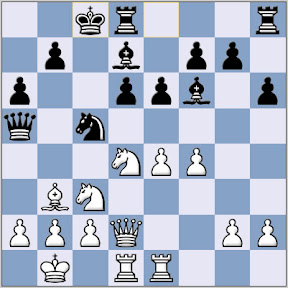
Ponomariov judged that his king would be safer tucked away on b8, rather than facing the full force on White's attack on the kingside.
I couldn't find any other examples on my databases of queenside castling in this line, although Malcolm Pein in his commentary for TWIC did find a short draw between Kogan and Efimenko after: 14 ... Qc7; 15 Nf3 0-0-0.
Rublevsky continued energetically:
15 Ncb5! Qb6; 16 Nxd6+ Qxd6; 17 e5 Qc7; 18 ef gf
but Ponomariov was able to develop good play against the White king. It'll be interesting to see if they repeat the line.
Scouring my books, I did come across a wild encounter where Latvian GM Igors Rausis, playing Black, also castled queenside in the Sicilian:
Ambroz,J - Rausis,I [B51]
Germany 1989
1.e4 c5 2.Nf3 d6 3.Bb5+ Nc6 4.0-0 Bg4 5.h3 Bh5 6.c3 Qb6 7.Ba4 Nf6 8.Re1 e6 9.d4 cxd4 10.cxd4 d5 11.exd5 Nxd5 12.Nc3 0-0-0?!
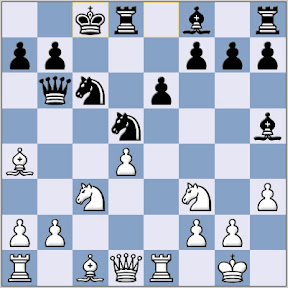
With the c-file open, this looks a crazy place to put the king.
13.Bxc6 Qxc6 14.Nxd5 Qxd5 15.g4 Bg6 16.Re5?! Qd7 17.Be3 Bd6 18.Ra5 b6 19.Ne5 Bxe5 20.Rxe5 f6?! 21.Qf3!
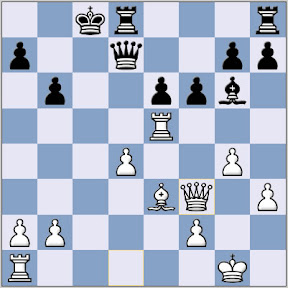
White has lost a rook, but has tremendous attacking chances the Black king. Incredibly, in just 14 more moves, the Black king ends up on g3 as the final piece in a mating counter-attack!
21 ... fxe5 22.Qa8+ Kc7 23.Qxa7+ Kd6 24.Qa3+ Kc6 25.Qa6 exd4 26.Rc1+ Kd5 27.Qc4+ Ke5 28.Bg5 Rdf8 29.f4+? [29.Re1+ Be4 30.Qd3 Qc6 31.f3=] 29...Rxf4 30.Bxf4+ Kxf4 31.Qe2 Kg5 32.Qe5+ Kh4 33.Rf1 Qd5 34.Qxg7 [34.Qe1+ Kxh3 35.Rf2 e5-+] 34...Kg3!
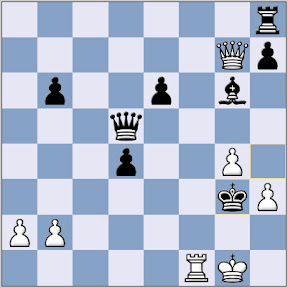
35.Qc7+ e5 36.Rf2 Rf8 37.Rd2 Qh1+ 0-1
There are numerous lines in the Sicilian Defence where White castles on the queenside, Black on the kingside, and attacks then rage on opposite wings of the board.
It's a much rarer sight to see Black castling queenside in the Sicilian, with the c-pawn removed there is little cover for the black king, but that is what Ponomariov tried against Rublevsky:
1 e4 c5; 2 Nf3 d6; 3 d4 cd; 4 Nxd4 Nf6; 5 Nc3 a6; 6 Bc4
This is the move that Nigel Short used in his attempts to bash Garry Kasparov's Najdorf Defence during their World Championship match.
6 ... e6; 7 Bb3 Nbd7; 8 Bg5 Qa5; 9 Qd2 Be7; 10 0-0-0 Nc5; 11 Rhe1 h6; 12 Bxf6 Bxf6; 13 Kb1 Bd7; 14 f4 0-0-0
Ponomariov judged that his king would be safer tucked away on b8, rather than facing the full force on White's attack on the kingside.
I couldn't find any other examples on my databases of queenside castling in this line, although Malcolm Pein in his commentary for TWIC did find a short draw between Kogan and Efimenko after: 14 ... Qc7; 15 Nf3 0-0-0.
Rublevsky continued energetically:
15 Ncb5! Qb6; 16 Nxd6+ Qxd6; 17 e5 Qc7; 18 ef gf
but Ponomariov was able to develop good play against the White king. It'll be interesting to see if they repeat the line.
Scouring my books, I did come across a wild encounter where Latvian GM Igors Rausis, playing Black, also castled queenside in the Sicilian:
Ambroz,J - Rausis,I [B51]
Germany 1989
1.e4 c5 2.Nf3 d6 3.Bb5+ Nc6 4.0-0 Bg4 5.h3 Bh5 6.c3 Qb6 7.Ba4 Nf6 8.Re1 e6 9.d4 cxd4 10.cxd4 d5 11.exd5 Nxd5 12.Nc3 0-0-0?!
With the c-file open, this looks a crazy place to put the king.
13.Bxc6 Qxc6 14.Nxd5 Qxd5 15.g4 Bg6 16.Re5?! Qd7 17.Be3 Bd6 18.Ra5 b6 19.Ne5 Bxe5 20.Rxe5 f6?! 21.Qf3!
White has lost a rook, but has tremendous attacking chances the Black king. Incredibly, in just 14 more moves, the Black king ends up on g3 as the final piece in a mating counter-attack!
21 ... fxe5 22.Qa8+ Kc7 23.Qxa7+ Kd6 24.Qa3+ Kc6 25.Qa6 exd4 26.Rc1+ Kd5 27.Qc4+ Ke5 28.Bg5 Rdf8 29.f4+? [29.Re1+ Be4 30.Qd3 Qc6 31.f3=] 29...Rxf4 30.Bxf4+ Kxf4 31.Qe2 Kg5 32.Qe5+ Kh4 33.Rf1 Qd5 34.Qxg7 [34.Qe1+ Kxh3 35.Rf2 e5-+] 34...Kg3!
35.Qc7+ e5 36.Rf2 Rf8 37.Rd2 Qh1+ 0-1
Wednesday, 30 May 2007
Qualifying for the British Chess Championships
One of the nice things about winning the Hartlepool Open at the weekend is that it qualified me to play in the British Chess Championships in August.
It's quite an honour to play in the Championships as well as a good opportunity to lock horns with some seriously strong players. On the downside:
It's quite an honour to play in the Championships as well as a good opportunity to lock horns with some seriously strong players. On the downside:
- it's ridiculously expensive... a £175 entry fee (about US $350), and the need to pay for accomodation for two weeks (it's an 11 round event)
- it's also in just about the most difficult place to get to in England... anyone know of a cool cottage (with a broadband connection) to rent in Great Yarmouth?
I'd say it's about 70-30 that I'll decide to play. I'll keep you updated on my preparations on Chess Tales.
Friday chess puzzle 7: the solution

Last Friday's chess puzzle was from Tigran Petrosian vs. Boris Ivkov 1979.
The solution:
1 Rxd4 any piece x d4; 2 Rxe5+ Kg4; 3 h3 mate
As Chris Wardle points out, mate isn't forced because Black can play 1 ... Ke6 rather than recaputring, but a piece down would just be losing.
This is a famous position which apparently some immediately see the solution to, whilst for others (of a similar rating) the idea takes quite a while to spot.
Queen's Pawn Game with ... d6
In the mid 1990's, an unusual opening setup for Black sprung to prominence:
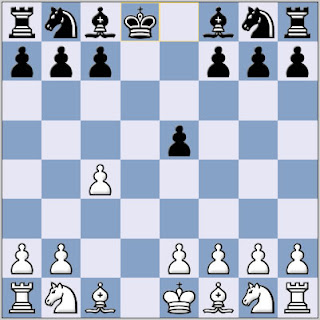
1 d4 d6; 2 c4 e5!?
Superficially, after the obvious response 3 de de; 4 Qxd8+ Kxd8 Black has lost the right to castle and consequently White appears to be doing well.
Results with the line told a different story though, Chessbase reveals (upto 1998) that Black was scoring a staggering 71% with the line, and the best White could hope for was the occasional grovelling draw. Since '98, White's results, if anything, have been even worse.
A deeper study of the position reveals the reasons behind this:
1 d4 d6; 2 c4 e5!?
Superficially, after the obvious response 3 de de; 4 Qxd8+ Kxd8 Black has lost the right to castle and consequently White appears to be doing well.

Results with the line told a different story though, Chessbase reveals (upto 1998) that Black was scoring a staggering 71% with the line, and the best White could hope for was the occasional grovelling draw. Since '98, White's results, if anything, have been even worse.
A deeper study of the position reveals the reasons behind this:
- Black's apparently weak king is under little threat with the Queen's off the board, e.g. after c7-c6 it can be safely tucked away on c7, and in some cases it's central position can even be an asset in quick transitions to a ending
- The c4 pawn restricts the scope of White's light squared bishop, Black can latch onto it as an easy target e.g. with ... Be6. Shifting the pawn is a time consuming task that leaves other weaknesses in it's wake
- Black has easy development with ... Nd7, ... Bc5 ideas, swapping the dark squared bishops and going into good knight / good bishop vs. bad bishop endings
- Any moves of the e-pawn (to e3 or e4) give Black potential invasion squares for a knight on either d3 or d4
- Black can play moves like ... f6 securing a strong central pawn on e5
It might not be terminal yet, but it's certainly no fun to play as White, and the opening definitely deserves a better name than "Queen's Pawn Game with ... d6". Suggestions for a name to roger AT 21thoughts DOT com.
So, should we give up playing d4 as White?
Well, perhaps not, Burgess and Pedersen
If this is not your cup of tea, my recommendation is not to take the pawn after 1 d4 d6; 2 c4 e5, but instead to play 3 Nf3 transposing into a line from the English opening (Chessbase reveals White scores a healthy 54% with this line!).
Some sample games:
Alexandru Crisan vs. Bartlomiej Macieja, Vidmar Memorial 2001 (a typical Black victory after 3 de de; 4 Qxd8+ Kxd8)
Jeroen Piket vs. Ilya Smirin, European Teams Championship 2001 (handling the White pieces after 3 Nf3 e4; 4 Ng5)
Tuesday, 29 May 2007
Queen's Gambit: Move Order Refinement
In two of my games at Hartlepool, Black sprang a 'move order refinement' on me in the Queen's Gambit Declined:
1 d4 d5; 2 c4 e6; 3 Nc3
and now instead of the usual 3 ... Nf6, Black played
3 ...Be7

This can be a particularly useful idea against opponents, myself included, who like to play the Exchange Variation, as it prevents the usual: 4 cd ed; 5 Bg5.
White can try 4 Nf3 and then after 4 ... Nf6; 5 cd ed; 6 Bg5 but this rules out one of the most dangerous variations of the Exchange where White develops the knight on e2 rather than f3.
Alternatively, if White still wants to play the Exchange Variation, he can adopt a setup with the bishop developed to f4 rather than g5, i.e. 4 cd ed; 5 Bf4 c6.
There is a second idea behind 3 ... Be7 as well, and that is the quick development of the c8 bishop to an active post on f5, i.e. 4 cd ed; 5 Bf4 c6; 6 e3 Bf5. (If Black goes 6 ... Bf5 after 3 ... Nf6 rather than 3 ... Be7 then White has the move 7 Qf3 after which he will saddle Black with doubled pawns on f6)
The light squared bishop can be a problem piece for Black in the Queen's Gambit, from f5 it is not only posted actively, but also stops White's standard attacking setup with Bd3 and Qc2. White can try his own move order refinement with 6 Qc2 instead of e3 to prevent 6 ... Bf5, but then Black has 6 ... g6 or 6 ... Bd6.
My knowledge of the lines beginning 1 d4 d5; 2 c4 e6; 3 Nc3 Be7; 4 cd ed; 5 Bf4 c6; 6 e3 Bf5 was very limited, but I did remember that Korchnoi had won a game against Karpov in their 1981 World Championship Match with the super sharp reply
7 g4

So, his was my choice in my 3rd round encounter with Andy Lawson at Hartlepool. After Andy's reply, 7 ... Be6, I knew 8 h4 was playable but wild, and instead adopted Korchnoi's choice against Karpov of 8 h3, and my initiative was enough force an advantage as Andy went wrong close to time control.
Coathup,R - Lawson,A [D31]
Hartlepool (3), 26.05.2007
1.d4 d5 2.c4 e6 3.Nc3 Be7 4.cxd5 exd5 5.Bf4 c6 6.e3 Bf5 7.g4 Be6 8.h3 Nd7 9.Nf3 Nb6 10.Bd3 Nf6 11.Ne5 Nfd7 12.Qc2 Nxe5 13.Bxe5 Bf6 14.Bf4 h5 15.0-0-0 Qe7 16.Kb1 a6 17.Rhg1 g5 18.Bg3 hxg4 19.hxg4 Bxg4 20.Rc1 Be6 21.Qb3 Nc4 22.Bxc4 dxc4 23.Qb6 Qd7 24.Na4 Bd8 25.Qc5 Be7 26.Qb6 Bd5 27.Nc5 Bxc5 28.Qxc5 Qe7 29.Bd6 Qe4+ 30.Ka1 Kd7 31.Be5 Rh6 32.Qb6 Ke6 33.Rxg5 Re8 34.Qc7 f6 35.Qd6+ Kf7 36.Rcg1 fxg5 37.Qxh6 Qg6 38.Qxg6+ Kxg6 39.Bf4 Rh8 40.Rxg5+ Kf7 41.Rg1 Ke6 42.Kb1 b5 43.Kc2 b4 44.a3 a5 45.axb4 axb4 46.Ra1 Rg8 47.Bg3 Kf5 48.Ra4 b3+ 49.Kc3 Ke4 50.Rxc4 Ra8 51.Rb4 Ra1 52.Rxb3 Bxb3 53.Kxb3 1-0
In the final round, Jimmy Simpson also played 3 ... Be7 against me. Suspecting he had specially prepared the line, and with me only needing a draw for the title, I adopted the 'safer' 4 Nf3 and went for a minority attack version of the Exchange Variation.
If you want to know more, I recommend taking a look at some of these books:
1 d4 d5; 2 c4 e6; 3 Nc3
and now instead of the usual 3 ... Nf6, Black played
3 ...Be7

This can be a particularly useful idea against opponents, myself included, who like to play the Exchange Variation, as it prevents the usual: 4 cd ed; 5 Bg5.
White can try 4 Nf3 and then after 4 ... Nf6; 5 cd ed; 6 Bg5 but this rules out one of the most dangerous variations of the Exchange where White develops the knight on e2 rather than f3.
Alternatively, if White still wants to play the Exchange Variation, he can adopt a setup with the bishop developed to f4 rather than g5, i.e. 4 cd ed; 5 Bf4 c6.
There is a second idea behind 3 ... Be7 as well, and that is the quick development of the c8 bishop to an active post on f5, i.e. 4 cd ed; 5 Bf4 c6; 6 e3 Bf5. (If Black goes 6 ... Bf5 after 3 ... Nf6 rather than 3 ... Be7 then White has the move 7 Qf3 after which he will saddle Black with doubled pawns on f6)
The light squared bishop can be a problem piece for Black in the Queen's Gambit, from f5 it is not only posted actively, but also stops White's standard attacking setup with Bd3 and Qc2. White can try his own move order refinement with 6 Qc2 instead of e3 to prevent 6 ... Bf5, but then Black has 6 ... g6 or 6 ... Bd6.
My knowledge of the lines beginning 1 d4 d5; 2 c4 e6; 3 Nc3 Be7; 4 cd ed; 5 Bf4 c6; 6 e3 Bf5 was very limited, but I did remember that Korchnoi had won a game against Karpov in their 1981 World Championship Match with the super sharp reply
7 g4

So, his was my choice in my 3rd round encounter with Andy Lawson at Hartlepool. After Andy's reply, 7 ... Be6, I knew 8 h4 was playable but wild, and instead adopted Korchnoi's choice against Karpov of 8 h3, and my initiative was enough force an advantage as Andy went wrong close to time control.
Coathup,R - Lawson,A [D31]
Hartlepool (3), 26.05.2007
1.d4 d5 2.c4 e6 3.Nc3 Be7 4.cxd5 exd5 5.Bf4 c6 6.e3 Bf5 7.g4 Be6 8.h3 Nd7 9.Nf3 Nb6 10.Bd3 Nf6 11.Ne5 Nfd7 12.Qc2 Nxe5 13.Bxe5 Bf6 14.Bf4 h5 15.0-0-0 Qe7 16.Kb1 a6 17.Rhg1 g5 18.Bg3 hxg4 19.hxg4 Bxg4 20.Rc1 Be6 21.Qb3 Nc4 22.Bxc4 dxc4 23.Qb6 Qd7 24.Na4 Bd8 25.Qc5 Be7 26.Qb6 Bd5 27.Nc5 Bxc5 28.Qxc5 Qe7 29.Bd6 Qe4+ 30.Ka1 Kd7 31.Be5 Rh6 32.Qb6 Ke6 33.Rxg5 Re8 34.Qc7 f6 35.Qd6+ Kf7 36.Rcg1 fxg5 37.Qxh6 Qg6 38.Qxg6+ Kxg6 39.Bf4 Rh8 40.Rxg5+ Kf7 41.Rg1 Ke6 42.Kb1 b5 43.Kc2 b4 44.a3 a5 45.axb4 axb4 46.Ra1 Rg8 47.Bg3 Kf5 48.Ra4 b3+ 49.Kc3 Ke4 50.Rxc4 Ra8 51.Rb4 Ra1 52.Rxb3 Bxb3 53.Kxb3 1-0
In the final round, Jimmy Simpson also played 3 ... Be7 against me. Suspecting he had specially prepared the line, and with me only needing a draw for the title, I adopted the 'safer' 4 Nf3 and went for a minority attack version of the Exchange Variation.
If you want to know more, I recommend taking a look at some of these books:
Monday, 28 May 2007
Bent Larsen vs. Boris Spassky, 1970

In today's post about the Nimzo-Larsen Opening, I mentioned the spectacular performance by Boris Spassky where he routed Bent Larsen, one of the world's strongest chess players. Spassky, playing Black, sacrificed a knight and a rook to decisively queen a pawn and win in just 17 moves.
Our scan, taken from Cafferty's book "Spassky's 100 Best Games", gives detailed analysis of the game, which was played in 1970 Rest of the World vs. USSR match.
For those who prefer to just bash through the moves:
Bent Larsen - Boris Spassky, Rest of World vs. USSR 1970
1 b3 e5; 2 Bb2 Nc6; 3 c4 Nf6; 4 Nf3 e4; 5 Nd4 Bc5; 6 Nxc6 dc; 7 e3 Bf5; 8 Qc2 Qe7; 9 Be2 0-0-0; 10 f4? Ng4!; 11 g3 h5; 12 h3 h4!; 13 hg hg; 14 Rg1 Rh1!!; 15 Rxh1 g2; 16 Rf1 Qh4+; 17 Kd1 gf=Q+ 0-1
Nimzo-Larsen Opening
My second round opponent at Hartlepool was Clive Waters. Although Clive and I have battled many times over the last few years, predicting the opening is seldom possible. I had the Black pieces at Hartlepool and prepared for this game by looking at the Torre Attack, the London System , and even some lines in the c3 Sicilian. It was a complete surprise, when after a few minutes thought Clive played 1 b3, the Nimzo-Larsen opening.
Black can play moves like Nf6 then e6 in response (or any number of other setups), but the most direct response is to 'accept the challenge' and setup a big centre with ... e5 and ... d5, which can quickly lead to very rich play. I don't know any theory in the opening, although I was vaguely aware of 2 games: Karpov beating Browne with 1 c4 c5; 2 b3 Nf6; 3 Bb2 g6?; 4 Bxf6! and Karpov soon had a winning ending, and a humdinger of a game between Larsen and Spassky, where Spassky had aimed for the big centre and won with a brilliant kingside attack (more in a later post).
So, our game continued:
1 ... e5; 2 Bb2 Nc6; 3 e3 d5; 4 Bb5 Bd6

And now White can challenge the centre with the double edged 5 f4 looking to exploit the pin on the e5 pawn (g7 is undefended). When Black can continue with 5 ... Qe7; 6 Nf3 f6 or play 5 ... Qh4+; 6 g3 Qe7; 7 Nf3 Bg4 with a good game.
Instead Clive chose to increase the pressure whilst developing quickly with:
5 Nf3 Qe7; 6 d4 e4; 7 Ne5

In this position, which has the characteristics of a reverse French, Black has a very interesting possibility: 7 ... Qg5! If White now captures on c6 he ends up in a poor position, e.g. 8 Nxc6 Qxg2; 9 Rf1 a6 with advantage to Black.
I didn't consider this during the game, and immediately replied with:
7 ... Bd7
and Clive continued his energetic 'forcing' line:
8 Nxd7 Qxd7; 9 c4 a6; 10 cd ab; 11 dc bc; 12 Nd2 Nf6; 13 Qc2 Bb4; 14 a3 Bxd2+; 15 Qxd2

This is the position both players had envisioned back on move 7, and the question is how to assess it:
The position still resembles a reverse French in many ways. Black has a collection of weak pawns, e4, c6 and c7 (backward and doubled on a half open file), but they are difficult to attack successfully. As compensation Black's knight is superior to White's bad 'French' bishop, and Black can perhaps generate some counterplay down the a-file or against the White king once it castles (with 0-0, Re8, Re6, Rg6 etc).
My verdict: slight advantage to White. He can tie Black down to defending c6, but it's difficult to see how he makes progress.
The game continued:
15 ... 0-0; 16 0-0 Rfe8; 17 a4 Nd5; 18 Bc3 Qd6; 19 Qc2 Ra6; 20 Bd2 f5; 21 Rfc1 Rea8; 22 a5 b4; 23 Qc5 Rb8; 24 g3 Rb5; 25 Qxd6 cd; 26 Rc4? c5!; 27 dc dc; 28 Bc1 Rbxa5; 29 Rxa5 Rxa5
And Black, a pawn up, went on to win the ending. We'll look at the ending in detail in a later post.
Black can play moves like Nf6 then e6 in response (or any number of other setups), but the most direct response is to 'accept the challenge' and setup a big centre with ... e5 and ... d5, which can quickly lead to very rich play. I don't know any theory in the opening, although I was vaguely aware of 2 games: Karpov beating Browne with 1 c4 c5; 2 b3 Nf6; 3 Bb2 g6?; 4 Bxf6! and Karpov soon had a winning ending, and a humdinger of a game between Larsen and Spassky, where Spassky had aimed for the big centre and won with a brilliant kingside attack (more in a later post).
So, our game continued:
1 ... e5; 2 Bb2 Nc6; 3 e3 d5; 4 Bb5 Bd6

And now White can challenge the centre with the double edged 5 f4 looking to exploit the pin on the e5 pawn (g7 is undefended). When Black can continue with 5 ... Qe7; 6 Nf3 f6 or play 5 ... Qh4+; 6 g3 Qe7; 7 Nf3 Bg4 with a good game.
Instead Clive chose to increase the pressure whilst developing quickly with:
5 Nf3 Qe7; 6 d4 e4; 7 Ne5

In this position, which has the characteristics of a reverse French, Black has a very interesting possibility: 7 ... Qg5! If White now captures on c6 he ends up in a poor position, e.g. 8 Nxc6 Qxg2; 9 Rf1 a6 with advantage to Black.
I didn't consider this during the game, and immediately replied with:
7 ... Bd7
and Clive continued his energetic 'forcing' line:
8 Nxd7 Qxd7; 9 c4 a6; 10 cd ab; 11 dc bc; 12 Nd2 Nf6; 13 Qc2 Bb4; 14 a3 Bxd2+; 15 Qxd2

This is the position both players had envisioned back on move 7, and the question is how to assess it:
The position still resembles a reverse French in many ways. Black has a collection of weak pawns, e4, c6 and c7 (backward and doubled on a half open file), but they are difficult to attack successfully. As compensation Black's knight is superior to White's bad 'French' bishop, and Black can perhaps generate some counterplay down the a-file or against the White king once it castles (with 0-0, Re8, Re6, Rg6 etc).
My verdict: slight advantage to White. He can tie Black down to defending c6, but it's difficult to see how he makes progress.
The game continued:
15 ... 0-0; 16 0-0 Rfe8; 17 a4 Nd5; 18 Bc3 Qd6; 19 Qc2 Ra6; 20 Bd2 f5; 21 Rfc1 Rea8; 22 a5 b4; 23 Qc5 Rb8; 24 g3 Rb5; 25 Qxd6 cd; 26 Rc4? c5!; 27 dc dc; 28 Bc1 Rbxa5; 29 Rxa5 Rxa5
And Black, a pawn up, went on to win the ending. We'll look at the ending in detail in a later post.
Sunday, 27 May 2007
First at Hartlepool Chess Tournament
I won the Hartlepool Chess Tournament. It's been a couple of years since my last victory, so it's a good feeling to get back to winning ways.
I followed the 3 points from the first 3 rounds with a victory this morning, and then scraped a draw in the afternoon to finish on 4.5 out of 5. Jonathan Hawkins finished second.
Games and commentary to follow this week, but at the moment I need dinner!
I followed the 3 points from the first 3 rounds with a victory this morning, and then scraped a draw in the afternoon to finish on 4.5 out of 5. Jonathan Hawkins finished second.
Games and commentary to follow this week, but at the moment I need dinner!
Saturday, 26 May 2007
Hartlepool update
Thanks to some good fortune and to some tenacious play I'm leading the Hartlepool Chess Tournament with 3 out of 3. Club mate and occasional Chess Tales contributor, Paul Dargan, is one of 2 players just half a point behind. We play the final 2 rounds tomorrow.
The first round saw me 'blunder' a pawn opening the centre in a Queen's Gambit Exchange Variation, although the attack I managed to whip up proved more than adequate compensation. Round 2 saw me up against a long time rival, all my opening preparation went out the window when he opened up with 1 b3. I picked up a pawn around time control, and it was then just a matter of technique. Round 3 was an opponent against whom I've had bad results over the years, but on this occasion I was able to turn a rook and opposite bishop ending with an extra pawn into a won bishop and 3 pawns vs. rook ending.
There's been some interesting openings and endings, that we'll take a closer look at later in the week.
Apologies for the slow posting over the last few days; it proved difficult to get an Internet connection at the tournament.
The first round saw me 'blunder' a pawn opening the centre in a Queen's Gambit Exchange Variation, although the attack I managed to whip up proved more than adequate compensation. Round 2 saw me up against a long time rival, all my opening preparation went out the window when he opened up with 1 b3. I picked up a pawn around time control, and it was then just a matter of technique. Round 3 was an opponent against whom I've had bad results over the years, but on this occasion I was able to turn a rook and opposite bishop ending with an extra pawn into a won bishop and 3 pawns vs. rook ending.
There's been some interesting openings and endings, that we'll take a closer look at later in the week.
Apologies for the slow posting over the last few days; it proved difficult to get an Internet connection at the tournament.
Chess improvement tips: summary
The structured chess improvement tips series that we've run over the last 6 weeks has been incredibly well received. This post concludes the series, giving you an index and some pointers to the future.
Chess Tales improvement tips:
- Introduction
- Know yourself
- Annotate your games
- Annotating your games: further pointers
- Your endgame databank
- Studying the classics
- Selecting your openings
- Learning an opening
- Tactical awareness
- Extending your repertoire
These are also the elements around which we base the Chess Tales coaching programme. Drop me a line on roger AT 21thoughts DOT com if you'd like to know more about our chess coaching.
I'll continue to post improvement tips (opening reviews, classic games, middlegame strategies, essential endings, etc.) on a less structured basis over the coming weeks. Please let me know which areas you'd like to see covered.
If you are looking for some great chess literature to help you in your studies, you should check out the Chess Tales 'must have' books list.
Friday, 25 May 2007
Friday chess puzzle 7
This week's Friday chess puzzle is from Tigran Petrosian vs. Boris Ivkov 1979. The position is quite well known, so apologies if you've seen it before.
The question is: how did Petrosian, White to play, force a quick checkmate?
Thursday, 24 May 2007
Chess in Zaragoza

Last week we were privileged to have Paul Dargan talk about chess in Amsterdam. Today, another team mate of mine, Antonio Moneva Jordan, contributes an inspiring piece about chess in his home city, Zaragoza in the Aragon region of Spain. I know where I want to play this summer.
Chess in Zaragoza is as popular as ever. Just 2 weekends ago the great Anatoly Karpov visited the city to promote a city tournament and play some exhibition chess. The highlight of the weekend events was a large outdoor simultaneous display at the city centre comprising 250 boards. Karpov started the opening move in all of them and then concentrated in 14 selected boards while other masters continued the rest of the games. Over 400 participants of all ages enjoyed the event and loved getting their photograph with the former World Champion.
In the end Karpov won 13 out the 14 games and only conceded a draw against an old friend and FIDE master Cristobal Ramo. Interestingly, Cristobal beat Garry Kasparov 21 years ago in another outdoor simul in the city, soon after Garry became World Champion. When we were young kids Cristobal and I played for the same club (Helios) and even represented our school team (Maristas) where he was a great top board and I was a very distant second.
Ever since I was a kid, playing chess outdoors in late spring and summer has been very popular in Zaragoza, often simultaneous displays to attract youngsters to the game. In Spain chess is generally more popular than in the UK and is almost considered a sport. I once took part in a gruelling 24 hour chess marathon in Galicia consisting of 6 one hour games, followed by 6 30 minute games, to finish off with 6 five minute games, all pretty much in succession. It certainly felt like the hardest sport I had ever played...
A number of top GMs reside in Spain including Anand, Shirov and Topalov to name only a few. Before his ascendency to glory Topalov used to tour the country winning open tournament after tournament. Chess in Spain has prospered since Lucena's writings in the XV century to the very famous 1985 World championship in Sevilla between Kasparov and Karpov. Zaragoza is holding the International Exposition (Expo) in 2008. Hopefully it will serve to further promote chess in this great city.Antonio Moneva Jordan
Garry Kasparov - Cristobal Ramo Frontinan, Zaragoza Simul 1986
1.e4 c6 2.d4 g6 3.f4 d5 4.e5 h5 5.Nf3 Nh6 6.Be3 Bg7 7.Nbd2 Bf5 8.h3 Nd7 9.Bf2 Nf8 10.c3 Ne6 11.g3 Rc8 12.b4 a5 13.a3 axb4 14.axb4 Ra8 15.Ng5 Rxa1 16.Qxa1 0-0 17.Be2 Qa8 18.0-0 Nc7 19.Kh2 Qc8 20.Qd1 f6 21.Ngf3 Bxh3 22.Nh4 Bxf1 23.Nxf1 Kh7 24.Ne3 f5 25.c4 Qe6 26.b5 dxc4 27.Nf3 Qd7 28.Ng5+ Kh8 29.bxc6 bxc6 30.Bxc4 Nd5 31.Qb3 e6 32.Bxd5 cxd5 33.Qb6 Re8 34.Be1 Ng4+ 35.Nxg4 hxg4 36.Bb4 Bh6 37.Qd6 Qxd6 38.exd6 Bxg5 39.fxg5 Rd8 40.Kg2 Kg7 41.Kf2 Kf7 42.Ke3 Ke8 43.Kf4 Kd7 44.Ke5 Rf8 0-1
Wednesday, 23 May 2007
Chess photo question: answer
Sunday's photo question asked you to name the two famous players watching Viktor Korchnoi ponder his next move against Garry Kasparov:

Most of you had no problem spotting Anatoly Karpov in the turtle neck sweater. The game was played during the Soviet boycott of Korchnoi, and Karpov was 'rested' for the match with Switzerland to avoid a potentially embarrassing encounter.
The player peering over Korchnoi's shoulder proved harder to identify. It is Alexander Beliavsky. At the time Beliavsky was regarded as a potential future World Champion but, despite winning the Soviet championship twice and the World Junior title, he has only qualified once for the Candidates matches, losing to Garry Kasparov in 1983. He is currently the second oldest player in the top 100 (Korchnoi is the oldest).

Most of you had no problem spotting Anatoly Karpov in the turtle neck sweater. The game was played during the Soviet boycott of Korchnoi, and Karpov was 'rested' for the match with Switzerland to avoid a potentially embarrassing encounter.
The player peering over Korchnoi's shoulder proved harder to identify. It is Alexander Beliavsky. At the time Beliavsky was regarded as a potential future World Champion but, despite winning the Soviet championship twice and the World Junior title, he has only qualified once for the Candidates matches, losing to Garry Kasparov in 1983. He is currently the second oldest player in the top 100 (Korchnoi is the oldest).
Hartlepool Chess
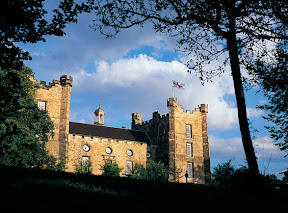
I'm going to play in the Hartlepool Chess tournament this weekend; It's a typical 5 round English swiss tournament, 1 round on Friday evening, 2 on Saturday and 2 on Sunday.
Hartlepool, for those of you who don't know it, could be regarded as England's answer to Springfield: It has a nuclear power station and recently elected a guy dressed in a monkey outfit as its mayor (it's a long story going all the way back to the Napoleonic wars). Its football team has just won promotion and the pies at Greggs are always hot.
The tournament venue, an upstairs function room at a hotel / bar in the centre of the town, is one of the most crowded, hot and uncomfortable you could find, but the quality of the competition is usually good. I finished second there a couple of years back, walking away with a decent cheque after watching all the other last round games finish favourably for me. Having said that, the cheque bounced! In fairness, it did clear a week later.
I'll be 'preparing' for the event by attending a conference on Friday at Lumley Castle. I might also be revising some opening lines. Lumley is one of those dream hotels, with bedrooms scattered throughout the Castle. It has fantastic views over a new International cricket ground; when the visiting Australian cricket team stayed they apparently resorted to sleeping on each other's floor because of fear of the ghosts... how on earth did we lose to them!
Tuesday, 22 May 2007
Friday chess puzzle 6: An apology
Apologies to all of you who spent time looking for the 'forced mate' solution to Friday's chess puzzle.
Unfortunately, there isn't one... the line played in the game, and the expected 'solution' was:
1 ... Qh2+; 2 Kxh2 Rxf1+; 3 Kh3 Rh5+; 4 Kg4 Rf4+; 5 Kg3 Rff5+; 6 Kg4 Rfg5 mate
But, there is a hole in this: instead of 4 Kg4, White can play 4 Qh4. Black is still considerably better but the immediate mate is prevented.
As other first moves for Black also lead to considerable advantage, the puzzle is somewhat spoiled. My post earlier this week had more on the theme of the aesthetic (in this case the queen sacrifice on h2) vs practical in chess.
I'll try to do better with this week's puzzle.
Unfortunately, there isn't one... the line played in the game, and the expected 'solution' was:
1 ... Qh2+; 2 Kxh2 Rxf1+; 3 Kh3 Rh5+; 4 Kg4 Rf4+; 5 Kg3 Rff5+; 6 Kg4 Rfg5 mate
But, there is a hole in this: instead of 4 Kg4, White can play 4 Qh4. Black is still considerably better but the immediate mate is prevented.
As other first moves for Black also lead to considerable advantage, the puzzle is somewhat spoiled. My post earlier this week had more on the theme of the aesthetic (in this case the queen sacrifice on h2) vs practical in chess.
I'll try to do better with this week's puzzle.
Swapping the French bishop
Black's biggest problem in the French Defence is his light squared bishop that often remains passive, restricted by the pawns on e6 and d5. The problem can be so bad that French players are often willing to spend several tempi in the opening just to swap it off, e.g. in the Winawer variation:
1 e4 e6; 2 d4 d5; 3 Nc3 Bb4; 4 e5 where Black plays 4 ... b6, intending to follow up with ... Ba6.
The trouble with this Winawer line is that White can utilise the time gained to either attack on the king side or build a big advantage in development, e.g. after 5 a3 Bf8; 6 Bb5+ or an immediate 5 Qg4.
I prefer the early bishop swap concept against the Advance variation (particularly as players of the Advance variation are typically the sort who love their light squared bishop hitting against h7). In the Advance, a small change in move order, delaying Nc6, is used to 'disguise' the bishop swap idea:
1 e4 e6; 2 d4 d5; 3 e5 c5; 4 c3 Qb6; 5 Nf3 Bd7; 6 Be2 cd; 7 cd Bb5
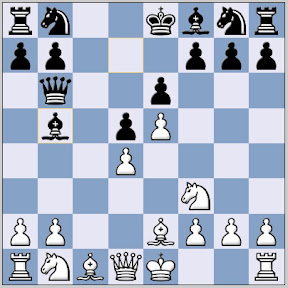
The bishops are coming off, costing White a key attacking piece, and the nature of the game becomes a clear battle between Black's play down the c-file and White's space advantage.
Note: Black played 6 ... cd first to avoid giving White the option to meet ... Bb5 with c4.
From this Kupreichik - Eingorn, USSR 1977 went:
8 Bxb5+ Qxb5; 9 Nc3 Bb4!; 10 Bd2 Qd3; 11 Qa4+ Nc6 with an equal game.
In my game against David Henderson from the Northumberland County Championships in 1994, David tried:
8 0-0 but after 8 ... Bxe2; 9 Qxe2 Nc6; 10 Nc3 Nge7; 11 Rd1 Nf5; 12 Be3 Be7 Black went on to win.
1 e4 e6; 2 d4 d5; 3 Nc3 Bb4; 4 e5 where Black plays 4 ... b6, intending to follow up with ... Ba6.
The trouble with this Winawer line is that White can utilise the time gained to either attack on the king side or build a big advantage in development, e.g. after 5 a3 Bf8; 6 Bb5+ or an immediate 5 Qg4.
I prefer the early bishop swap concept against the Advance variation (particularly as players of the Advance variation are typically the sort who love their light squared bishop hitting against h7). In the Advance, a small change in move order, delaying Nc6, is used to 'disguise' the bishop swap idea:
1 e4 e6; 2 d4 d5; 3 e5 c5; 4 c3 Qb6; 5 Nf3 Bd7; 6 Be2 cd; 7 cd Bb5
The bishops are coming off, costing White a key attacking piece, and the nature of the game becomes a clear battle between Black's play down the c-file and White's space advantage.
Note: Black played 6 ... cd first to avoid giving White the option to meet ... Bb5 with c4.
From this Kupreichik - Eingorn, USSR 1977 went:
8 Bxb5+ Qxb5; 9 Nc3 Bb4!; 10 Bd2 Qd3; 11 Qa4+ Nc6 with an equal game.
In my game against David Henderson from the Northumberland County Championships in 1994, David tried:
8 0-0 but after 8 ... Bxe2; 9 Qxe2 Nc6; 10 Nc3 Nge7; 11 Rd1 Nf5; 12 Be3 Be7 Black went on to win.
Monday, 21 May 2007
How not to play the Scandanavian Defence

A few weeks ago I was asked if I would suggest some lines for Black in the Scandanavian Defence following 1 e4 d5; 2 ed Nf6. It's still on the back boiler, but I couldn't resist showing this example I discovered of "how not to play the Scandanavian Defence".
The game was played at the Havana Olympiad in 1966 in the match between the USSR and Monaco. The first round of the Olympiad can throw up some terrible mis-matches, as witnessed in this encounter between future World Champion Boris Spassky and Mr Weiss from Monaco:
Boris Spassky - Weiss, Havana Olympiad 1966
1 e4 d5; 2 ed Nf6; 3 Bb5+ Bd7; 4 Bc4 Bf5; 5 Nc3 Nbd7; 6 d3 Nb6; 7 Qf3 Nxc4; 8 dc Bxc2; 9 Bf4
"From this point I stopped trying to guess my opponent's moves and I probably behaved somewhat tactlessly - I tried to sit at the board for as little time as possible" Boris Spassky
9 ... a6?; 10 Nge2 h6??; 11 0-0 Qc8; 12 Nd4 Bh7; 13 Rfe1 Rb8?; 14 h3 g5??; 15 Bxc7 Qxc7; 16 Qxf6 Rg8; 17 d6 Qd7; 18 Rxe7+ Bxe7; 19 Re1 Bg6; 20 Rxe7+ Kd8 and then Black resigned 1-0
You can find this, and 99 of Spassky's best games, in "Spassky's 100 Best Games" by Bernard Cafferty which has recently been re-released:
Sunday, 20 May 2007
Epic chess game photo question
There are a small handful of chess games that deserve the title 'epic'. Of those, some are remembered as much for their off the board significance as for the game itself. One can think of Botvinnik - Capablanca 1938, heralding a new Soviet dominated era, and of Spassky - Fischer 1970, a defiant last stand at the Olympiad from the World Champion against the relentless progress of the American.
Viktor Korchnoi vs. Garry Kasparov at the Luzern Olympiad 1983 is arguably the greatest of them all. The Soviet defector, who the Russians refused to play against in regular tournaments, vs. the rising young star of world chess.
The game, a super sharp Modern Benoni, didn't disappoint. Kasparov sacrificed a pawn, but Korchnoi fought fire with fire. Both sides exchanged great moves interspersed with mistakes, until Korchnoi, under severe time pressure, finally went down. You can play through this wonderful game online.
The photo, during the tense middlegame, captures Korchnoi in thought over his move and a concerned looking Kasparov. Our question is can you name the two famous players watching over Korchnoi's left shoulder?
Chess in the Attic: May 1979

As Garry Kasparov struggles against Vladimir Putin's latest clampdowns on democracy, today's Chess in the Attic post remembers more carefree days back in 1979.
Garry Kasparov was just 16 years old and not even FIDE rated when he was invited to play in the Banja Luka tournament in Yugoslavia. His performance, winning by 2 clear points from a strong field that included former World Champion Tigran Petrosian and 13 other Grandmasters, was quite remarkable.

This was Garry's first Grandmaster norm, he completed the title when he won the Baku tournament the following spring.
Interestingly, despite the tournament concluding on the 2nd May, it wasn't reported until the July issue of Chess Magazine. Nowadays, in our Internet world, even having to wait a few hours for game scores and reports is considered poor practice.
Saturday, 19 May 2007
Chess improvement 8: Extending your repertoire
Garry Kasparov stated that a player should always be looking to broaden and deepen their opening repertoire. Some motivating factors for this might be:
- to find improvements and avoid variations that caused difficulty in previous games
- to surprise a regular or well prepared opponent
- to improve our chess playing ability by exploring different types of position
- the simple desire to try something new
I'll share with you a story about a technique that I used to extend my opening repertoire:
For many years, almost without fail, I've played the King's Indian Defence as Black against d4. My results were generally good, but I wanted to introduce some variety (regular opponents were well prepared for my defence, there were some lines were I didn't feel comfortable, and I felt that repeatedly playing the same strategic ideas by rote was stifling my creativity and making me lazy at the board).
Back in the late 80's I'd seen a game by Ljubojevic in the Semi-Slav that I really liked. I'd wanted to try the opening and plan, but didn't have the time / resources to build up a sufficient Black repertoire around the other alternatives that could follow 1 d4 d5.
Watching Kasparov's DVD review of the Queen's Gambit gave me the confidence to explore the opening further and led me to revisit Ljubojevic's game. Added to that line in the Semi-Slav, I also spent some time on the Cambridge Springs and on Lasker's early ... Ne4 in the orthodox Queen's Gambit Declined.
I wasn't happy with the position that Kasparov reached in the Cambridge Springs, so did a quick database search for other ideas tried by strong grandmasters: the search revealed 3 recent games that gave me a different approach to try in the variation.
Comforable that I now had a skeleton repertoire, I've been 'getting a feel' for 1 d4 d5 positions as Black by using it in Internet blitz games.
Summing up:
- Base your explorations around a key game where you like the strategic plan and ideas
- Try to find a good but easily absorbed overview of the opening (a DVD is great for this)
- Make sure you can identify plans / positional concepts that you feel comfortable with
- Use the Internet to build up experience and feel for playing the opening
Friday, 18 May 2007
Aesthetic vs practical in Chess

When researching today's chess puzzle, I came across this position from Westin - Karlsson, Stockholm 1973. Black won beautifully by 'walking into' a knight fork:
1 ... Kf7; 2 Nxd6+ Ke7; 3 Qxb5 Nf4+ with mate next move
There's no doubt that 1 ... Kf7 is an inspired and beautiful move. Indeed, Kotov awards it two exclamation marks in "Train Like a Grandmaster
 ", but is it the best move in the position? What if White declines to play the queen winning fork, and instead plays something like 2 Qd2? Black is still considerably better, but the game is prolonged.
The strongest moves in this position are in fact more straightforward options like 1 ... Rf6 or the more difficult to spot 1 ... Qe8 (see our previous post about pieces going backwards).
What gives us the greatest pleasure, the aesthetically beautiful concept or the best practical move? Would Reti - Alekhine have claimed it's place in chess history if Alekhine had played the routine but strong ... Ra3 instead of ... Re3?
I'll leave you to ponder this paradox between pleasure and perfection in chess, and to dream of the chance to play ... Kf7 or ... Re3!
Friday Chess Puzzle 6

Today's chess puzzle is from the game Agadzhanyan - Faibisovich, USSR 1977.
How did Black force a quick checkmate from this position?
Answers to roger AT 21thoughts DOT com
(This position features in Kotov's book "Train Like a Grandmaster
 ")
")
Kasparov stopped at airport
Garry Kasparov has had his passport and ticket taken by police preventing him from boarding a flight in Moscow. The Houston Chronicle has the story: Russian chess great stopped at airport
Thursday, 17 May 2007
Chess in Amsterdam: beer and a board

"Chess in Amsterdam: beer and a board" is the concluding part of Paul Dargan's report on his recent trip to Amsterdam. I lived in Amsterdam for a year, and reading Paul's articles am wondering why on earth I didn't play any chess over there. Anyway, over to Paul:
I have fond memories of playing in chess cafes on previous trips [to Amsterdam] such as Gambit. Unfortunately the proprietor passed away and the venue has been closed for a couple of years now. However, there is a new venue "De Laurierboom” (the laurel tree) that I wanted to check-out. I knew that Saturday is a bad day to find chess players in Holland as national league matches take place – but I walked to the café anyway in the hope of finding a game.
There were half a dozen people in the relatively small venue and although no-one was actually playing at 16:00 several were reading chess books or magazines (of which there was a plentiful supply). The atmosphere was very relaxed and I ordered a coffee from the bar – stronger options are available, there are six beers on tap!
I was easily able to get a game and must particularly thank Folker van Dorp for his hospitality as he steadfastly refused to let me buy a round of beers as we played 7 minute blitz. I also appreciated the way he adhered to the implicit rule of not playing the same line twice so after e4 c5 Nf3 e6 d4 cd c3 he felt obliged to take on c3 (rather than playing his normal choice d5) to avoid repeating a previous game. [Roger: check Paul's notes on a trap in the Morra Gambit]
Time flew by until Folker needed to meet his wife after a hard days shopping and I had to head to the airport. It was 19:00 and the café was beginning to fill-up. I guess there were 20 people now gathered round 4 boards and apparently it gets busier as people return from their league matches. Overall a very pleasant few hours in good company – heartily recommended if you find yourself with time in Amsterdam.
Paul Dargan
Chess in Amsterdam: books

As well as being a strong over the board chess player and a former British correspondence chess champion, Paul Dargan is also 'fortunate' enough to be able to jet around the world in the name of work.
Earlier this week, Paul shared a line in the Morra Gambit with us. Today he contributes a couple of posts about the chess scene in Amsterdam:
Recently my work took me to Holland and I had the opportunity to spend some personal time in Amsterdam. I lived in Holland for a year or so back in 1991 and remember the lively chess scene. Leiden, the city I lived, in had 7 (yes seven!) chess clubs then and the one I joined (LSG) had over 100 members. So in a city famed for its museums, red light district and euphemistically named “coffee shops” – what attractions are there for a chess player on a rainy day in Amsterdam?
I always like to have a look for interesting chess books that might not be readily available in the UK, and of course Holland has New In Chess publishing – as well as access to German publications so there were always likely to be a few gems to unearth.
So I headed for “het paard” (the knight) on Haarlemmerdijk (basically come out of central station, turn right and keep going). They have a good selection of books and software for chess, bridge, go, poker and backgammon – plus a wide range of boardgames. Ignoring the ubiquitous Gambit and Everyman books that I can get at home, my attention was caught by a couple of NIC publications that I hadn’t seen in the UK, that focus on very different styles of play.
“On the Attack" by Timman is a collection of attacking games by top players (Kasparov, Shirov, Topalov, Anand, Short, Polgar together with some less obvious choices) and instructive game fragments to illustrate both typical and unusual ideas. Browsing in the shop I recognised a fair proportion of the games from other sources (over a quarter) but the commentary and analysis were well balanced and I believe the book would be both entertaining and useful to players from average club players up to 2200, with great material in the second part for trainers and coaches.
“Endgame Virtuoso: Anatoloy Karpov” by Kirolyi does what it says on the tin. There are over 100 of Karpov’s endgames, presented in full – which allows readers to see the transition from opening to middlegame to endgame. Relatively light notes on the early stages of the games (except where key concessions are made that will impact on the ensuing ending) and what looked like pretty comprehensive analysis of the endings. A thematic index allows you to look-up endings that demonstrate particular techniques.
Eventually I felt that I had browsed long enough – and I really ought to buy something or leave the shop. Reviewing my Euro supply and doing a quick calculation of the rail fare to the airport, lunch and beer requirements I could afford only one of the two….those familiar with my play will have no difficulty in guessing which I chose.
They also have a wide range of second hand books available – in particular game collections of Keres and Bronstein caught my eye, so if you get there quick they might still be in stock.Paul Dargan
Wednesday, 16 May 2007
Winning with opposite coloured bishops
I seldom read a chess book from cover to cover, but Averbakh's "Chess Endings: Essential Knowledge " looks like being an exception. It's also been a fertile source of positions and puzzles for the Chess Tales blog.
Everyone 'well-schooled' chess player knows that opposite colour bishop endings are drawn, but here is a great example from Alexander Kotov - Mikhail Botvinnik, Moscow 1955, that shows this is not always the case:

Black is a pawn up, but the White king stops the b-pawn advancing and it appears that the White bishop can defend the king side pawns without a problem.
Botvinnik's winning plan involves creating a second passed pawn, his vision to achieve it, sacrificing his extra material is exceptional:
" looks like being an exception. It's also been a fertile source of positions and puzzles for the Chess Tales blog.Everyone 'well-schooled' chess player knows that opposite colour bishop endings are drawn, but here is a great example from Alexander Kotov - Mikhail Botvinnik, Moscow 1955, that shows this is not always the case:

Black is a pawn up, but the White king stops the b-pawn advancing and it appears that the White bishop can defend the king side pawns without a problem.
Botvinnik's winning plan involves creating a second passed pawn, his vision to achieve it, sacrificing his extra material is exceptional:
1 ... g5!!; 2 fxg5 d4+!
It's important to keep the advanced passed b-pawn. (Roger: the winning idea, 2 well separated passed pawns in an opposite coloured bishop ending is reasonably well known)
3 exd4 Kg3; 4 Ba3
4 Be7 Kxh4; 5 g6+ Kg4 does not help either.
4 ... Kxh4; 5 Kd3 Kxg5; 6 Ke4 h4; 7 Kf3 Bd5+ and White resigned.Yuri Averbakh, Chess Endings: essential knowledge
Sicilian Morra Gambit: The Siberian Trap
Paul Dargan has sent me this interesting post on a clever trap that can net Black an early point in the Morra Gambit. It's worth learning the pattern: it came up in one of my Internet blitzes this morning, from a game that started as a Benoni.
Paul got a chance to re-analyse the trap on a recent trip to Amsterdam, about which we'll post more later.
Paul got a chance to re-analyse the trap on a recent trip to Amsterdam, about which we'll post more later.
"We had fun messing around analysing a line of the Morra gambit that was becoming popular round about the time I stopped playing seriously in the early nineties – that can lead to some quick points against an unwary White. This line didn’t have a name back then, I discovered it in a copy of the excellent, but now defunct, “Inside Chess”. Now it seems to be known as the “Siberian Trap” or “Novosibirsk” variation. [ed: "Inside Chess" was a publication from Yasser Seirawan. It moved online when the print version ceased, and then to a annotated game column on ChessCafe.com. You can pick up back issues of the magazine on Amazon's US site: amazon.com]
1.e4 c5 2.Nf3 e6 3.d4 cxd4 4.c3 dxc3 5.Nxc3 Nc6 6.Bc4 Qc7 7.Qe2 Nf6 8.0–0All very typical Morra Gambit moves, that White often bashes out without too much thought
8... Ng4
But what's this? Isn't Black meant to curl up and defend, trying to win with his extra pawn?
9.h3?? (or Bb3, Bg5, etc) 9... Nd4!–+and Black is going to net the White Queen for two minor pieces due to the mate threat on h2.
Those interested in adding this line to their repertoire need to look at some of White’s more aggressive options – but note that Ng4 isn’t just a cheapo, the idea of moving the Knight to e5 to exchange one of White’s attacking minor pieces is positionally sound too. You do of course need to do some homework, I would suggest looking at:
9.Nb5 (Nd5 also gets played sometimes) Qb8 10.h3 h5 11.g3 from the diagram.Or earlier deviations by White, especially 8.e5 Ng4 9.Bf4 d5 (f6?! Has a worse reputation) 10.Bd3 when both Bb4 and Nb4 are worth investigation."
Paul Dargan

Tuesday, 15 May 2007
Chess in the Attic, March 1986

We used to have a number of strong international chess tournaments in the UK including Hastings, Philips and Drew, and Lloyds Bank. Now, sadly, only Hastings and the 'island' tournaments remain: strong opens in early autumn on Guernsey and particularly the event on the Isle of Man.
One tournament, from the good old days, that has always stuck in my mind was the GLC Chess Challenge in 1986; I was delighted when I discovered, in my attic, an old copy of British Chess Magazine covering the event.
The GLC Chess Challenge was remarkable for the performance of Glenn Flear. Glenn was an IM at the time and the second lowest rated player in the tournament. He was also not supposed to be playing; he only got his place when Anatoly Karpov withdrew at the last moment. Despite this, Glenn managed to win the tournament ahead of such great players as Boris Spassky, Nigel Short, Lajos Portisch,Pinter Ribli, Lev Polugayevsky, Bent Larsen, John Nunn, Jon Speelman and top seed Rafael Vaganian.
There was great human interest, because Glenn got married during the tournament to a leading French player. The 9th round was played early to allow him to attend the ceremony!
British Chess Magazine dubbed his feat as unprecedented in the 20th Century (the tournament victory not the marriage I believe), saying the only comparable achievement was Harry Pillsbury's at London in 1896.
We'll dig out some of Glenn's games for a future article.
Sunday, 13 May 2007
Garry Kasparov vs Mikhail Tal, Spartakiade 1983

Sunday's picture poser was Garry Kasparov scowling through Mikhail Tal's cigarette smoke. Congratulations to all who got it right including Ryan Emmet, chessloser and Prashant Jambunathan. The game, a super sharp Semi-Slav Botvinnik Variation, was played at the Spartakiade in the summer of 1983.
Today's picture from the September 1983 issue of Chess Magazine shows a different view of the same encounter. Their headline: "What a game!".
The Spartakiade was held in the interval between Garry Kasparov's Candidates match win over Alexander Beliavsky and his on-off-on Candidates encounter with Viktor Korchnoi.
Click on the image to read Alex Roshal's notes to this fabulous game; you can also play through the moves online.
Name the chess players

This picture captures one of the most famous games of chess played in the 1980's. Can you name the two players?
(inspired by Philippe Dornbusch's photo challenges)
Saturday, 12 May 2007
Chess improvement 7: Tactical awareness
Building your tactical awareness in chess will definitely net you some extra points, and also increase your enjoyment of the game: there's nothing better than finishing off a well played encounter with some tactical fireworks.
There are many books out there that can help you recognise and exploit basic tactical concepts such as double attacks, pins, skewers and forks, and some that will help you explore more complex themes such as enticement, deflection and interference. I'll give you a book list at the end.
Practice, practice, practice is the key. Once you are comfortable with the basic concepts, try to spend a few minutes each day on tactical problems. You'll start to build up a 'pattern library' in your brain and also stay 'chess sharp'. Remember as well that tactics aren't there just to win material, they can also be used to force mate, so don't neglect to study mating patterns.
Some recommendations (I've put most of them on the Chess Tales store at Amazon):
Fred Reinfeld produced a whole series of books on tactical themes including "Beginner's guide to winning chess", "Thousand and one winning sacrifices and combinations" and "How to force checkmate". There is also Leonard Barden's "Chess puzzle book". These books are still valuable, but if you fancy something more recent you could try Yasser Seirawan's "Winning chess tactics". Murray Chandler's "Chess tactics for kids" is also highly regarded.
If you are looking for something more advanced there is Valery Beim's "Understanding chess tactics". Gennady Nesis also produced a series of interesting tactics books that are based around complete illustrative games in key openings. They are definitely worth reading to enhance your understanding of an opening as well as to improve your tactical awareness: "Tactics in the Sicilian", "Tactics in the King's Indian", "Tactics in the French" and "Tactics in the Grunfeld".
Click here to see them on Amazon.
If you prefer your material on DVD, there are the fritz powerplay packages from Danny King including "Mating patterns" and "Tactics".
Last, but not least, there is the Chess tactics server on the Internet, started by the Hermsdorf Chess Club in Berlin and currently hosting close to 24,000 rated positions.
Next week, we'll look at a technique for enhancing your opening repertoire.
There are many books out there that can help you recognise and exploit basic tactical concepts such as double attacks, pins, skewers and forks, and some that will help you explore more complex themes such as enticement, deflection and interference. I'll give you a book list at the end.
Practice, practice, practice is the key. Once you are comfortable with the basic concepts, try to spend a few minutes each day on tactical problems. You'll start to build up a 'pattern library' in your brain and also stay 'chess sharp'. Remember as well that tactics aren't there just to win material, they can also be used to force mate, so don't neglect to study mating patterns.
Some recommendations (I've put most of them on the Chess Tales store at Amazon):
Fred Reinfeld produced a whole series of books on tactical themes including "Beginner's guide to winning chess", "Thousand and one winning sacrifices and combinations" and "How to force checkmate". There is also Leonard Barden's "Chess puzzle book". These books are still valuable, but if you fancy something more recent you could try Yasser Seirawan's "Winning chess tactics". Murray Chandler's "Chess tactics for kids" is also highly regarded.
If you are looking for something more advanced there is Valery Beim's "Understanding chess tactics". Gennady Nesis also produced a series of interesting tactics books that are based around complete illustrative games in key openings. They are definitely worth reading to enhance your understanding of an opening as well as to improve your tactical awareness: "Tactics in the Sicilian", "Tactics in the King's Indian", "Tactics in the French" and "Tactics in the Grunfeld".
Click here to see them on Amazon.
If you prefer your material on DVD, there are the fritz powerplay packages from Danny King including "Mating patterns" and "Tactics".
Last, but not least, there is the Chess tactics server on the Internet, started by the Hermsdorf Chess Club in Berlin and currently hosting close to 24,000 rated positions.
Next week, we'll look at a technique for enhancing your opening repertoire.
Friday, 11 May 2007
Chess on Peep Show

Chess made it onto Peep Show, British TV's top comedy programme, tonight. You can watch the whole episode online with Channel 4's on-demand service, 4oD, although last time I checked it wasn't compatible with Apple Macs (because of the DRM scheme)... which is kind of ironic as the Peep Show guys currently do the adverts for Macs over in the UK!
Naiditsch wins the Baku Chess International
Arkadij Naiditsch, playing Black, beat Nigel Short in the ninth round to win the Baku Chess International tournament.
Chess tournament photo question
Yesterday I mentioned two of the great tournaments of yester-year: London 1922 and New York 1924.
Philippe Dornbusch has a wonderful photo of another famous old tournament on his Chess and Strategy blog. The competitors captured include Lasker, Tarrasch, Alekhine, Capablanca, Nimzowitsch, Rubinstein, Marshall, Janowski, Blackburne and Gunsberg. He asks you to name the tournament. Hurry though, closing date is tomorrow.
Philippe Dornbusch has a wonderful photo of another famous old tournament on his Chess and Strategy blog. The competitors captured include Lasker, Tarrasch, Alekhine, Capablanca, Nimzowitsch, Rubinstein, Marshall, Janowski, Blackburne and Gunsberg. He asks you to name the tournament. Hurry though, closing date is tomorrow.
Update on Nigel Short
Nigel Short beat overnight leader Vadim Milov with the Black pieces in round 8 of the Baku Chess International.
He co-leads with 6.5 points and faces German GM Arkadij Naiditsch (2654) in the final round. Level with Short and Naiditsch on 6.5 are GMs Vadim Malakhatko and Gadir Guseinov.
The event is strong, with 8 of the players rated over 2600.
He co-leads with 6.5 points and faces German GM Arkadij Naiditsch (2654) in the final round. Level with Short and Naiditsch on 6.5 are GMs Vadim Malakhatko and Gadir Guseinov.
The event is strong, with 8 of the players rated over 2600.
Friday chess puzzle 5
Our first puzzle today is from Gata Kamsky vs. Judit Polgar from their second round game at Buenos Aires in 1994:

Judit began an attacking combination 5 moves previously, but Gata's threat to get a second queen with mate (d7-d8=Q) looks deadly. Can you see how Judit continued her combination and finished off the game quickly?
Our second puzzle is from Borisenko vs. Simagin at Moscow in 1955, and also features a White king on h3:

White will win if he can bring his king over the c file to assist his pawn, so, in response to 1 ... Qf1+, he played 2 Kg4. Can you see why this was a losing mistake?
Answers to roger AT 21thoughts DOT com. I'll post the solution next Wednesday.

Judit began an attacking combination 5 moves previously, but Gata's threat to get a second queen with mate (d7-d8=Q) looks deadly. Can you see how Judit continued her combination and finished off the game quickly?
Our second puzzle is from Borisenko vs. Simagin at Moscow in 1955, and also features a White king on h3:

White will win if he can bring his king over the c file to assist his pawn, so, in response to 1 ... Qf1+, he played 2 Kg4. Can you see why this was a losing mistake?
Answers to roger AT 21thoughts DOT com. I'll post the solution next Wednesday.
Thursday, 10 May 2007
Grandmaster interferes with play
When putting together this morning's piece about Buenos Aires 1994 I came across a witty anecdote about a grandmaster 'interfering with play'. It happened in the 9th round of the Lloyds Bank tournament that year, when English IM's, Gary Lane and Chris Ward were drawn together and both having realistic hopes of qualifying for the PCA Grand Prix:
"The tension was extreme as time drifted away, then in serious zeitnot, the two players blitzed out their remaining moves in order to attain the time control. A reconstruction was then required to see if they had indeed made the necessary 40 moves.
The tension fell, Lane and Ward took their place to finish their critical game. ...
Lane was thinking about his next move when suddenly the Estonian GM Lembit Oll passed behind Lane, reached over his shoulder picked up the queen and placed it on e4!! Completely dumbfounded, the two players explained that rather than analyzing they were in fact still playing. Shocked by his mistake Oll blushed and immediately ran out of the playing hall.
Coming back to their senses, the two Englishmen could not restrain themselves from bursting out laughing. Other players naturally (who had not seen the incident) asked them to be quiet, whereupon Lane and Ward explained what had happened which led equally naturally to general uproar!
The story doesn't end there; everyone then settled back down to their games and Lane, after some thought, played the move suggested by Oll: 45 Qg4-e4(!)
Phlegmatically, Chris Ward wryly smiled to his opponent and coined the phrase: 'The move recommended by the grandmaster!'", Christophe Gueneau, Sicilian Love
Chess in the Attic - Buenos Aires 1994

One of my recent re-discoveries on a visit to the attic was "Sicilian Love", not, as some may have believed, an old Barbara Cartland but a wonderful hardcover book about a Chess Tournament in Buenos Aires in 1994.
Well annotated books of great tournaments, e.g. London 1922, New York 1924 and Zurich 1953, used to be eagerly anticipated works of chess literature, but with an increasing number of tournaments, grandmasters, and most recently the immediate availability of games via the Internet, they are almost non-existent nowadays.
Buenos Aires 1994 was also unusual in a number of other ways: firstly it was held as a 60th birthday celebration for Lev Polugayevsky, and secondly it was a themed tournament, every game was an Open Sicilian (Polugayevsky's favourite opening).
Salov, a late replacement when Polugayevsky himself was unable to compete following an operation, won the double round tournament ahead a field of marvellous players: Anand, Ivanchuk, Polgar, Karpov, Kamsky, Shirov and Ljubojevic.
The book contains photographs, sketches, a discussion of 10 memorable Sicilians by Polugayesky, an interview with him, a history of the Sicilian Defence by French author Christophe Gueneau, a fascinating tournament report, and then 130 pages dedicated to the games with notes by Jeroen Piket. It's a veritable bible for anyone thinking about playing the opening.
"Sicilian Love" was published by New in Chess, but unfortunately is difficult to obtain now. London 1922, New York 1924 and Zurich 1953 are all available via Amazon (click on images below):


Wednesday, 9 May 2007
Knocked out!
Our campaign in the summer chess cup came to an in-glorious end last night when we were knocked out by Jesmond.
Based on the handicap system, a 3-1 result would have seen us through, and things were looking bright when they defaulted on bottom board and Paul Dargan worked his customary magic (more later) to quickly put us 2-0 up.
It then became a tale of two positions that on face of it appeared good for us, but where deeper inspection revealed considerable difficulties:


I'm playing White in the left hand position. I'd messed up a good situation from the opening, and then went in for this position thinking that with Black's knight 'offside' on h5 and queen 'out of the game' on b2, I would still be able to drum up some winning tries. It turns out though that both the queen and knight (controlling g3 and h4) are well positioned, and that White has considerable difficulties, e.g. after Rb1 Qd2, Black is threatening Qe3+, meanwhile Black's a8 rook is threatening to join the game with tempo. Unbelievably White is probably losing already; after 18 minutes thought I found one of the quickest ways:
1 Qb3?? Rxe2 0-1
So, with the score 2-1, Darren Laws had to win his game (right hand position). He's a pawn up but it looks difficult to win: after
1 ... Rb2 (correction, I'd initially posted Rb1+); 2 Nf1 (as 2 Rd3 loses to Rxd2; 3 Rxd2 Nf3+)
You suddenly realise it's even worse than that: White has no constructive moves and can only sit and wait for Black to improve his position. Desperately short of time and needing to win, Darren eventually sacrificed 2 pawns to break his king out of the prison, but the ending was then lost and the flag fall put both Darren and our team out of its misery!
On a happier note, let's finish with Paul Dargan's win. Playing a Sveshnikov as Black, he's generated a typical sicilian counter-attack, reaching this position after White's 17th move:

Here Paul played 17 ... Rc8! and after
18 Kf1? Rxc3! had a crushing attack. The game finished 19 h3 Rxd3!; 20 c3 Be2+; 21 Kel Rxc3! (sacrificing the same rook for the third time!); 22 fe Rc2; 23 f4 Qxd2+; 24 Kf2 Bd3 mate
Analysis shows that White had no good defence after 17 ... Rc8!, Paul gives a variation in ending a beautiful smothered mate if White tries 18 Be2:
18 ... Bxe2; 19 Nxe2 Nf3+; 20 Kf1 Nxd2+; 21 Ke1 Nf3+; 22 Kf1 Qe1+; 23 Rxe1 Nd2 mate:

Based on the handicap system, a 3-1 result would have seen us through, and things were looking bright when they defaulted on bottom board and Paul Dargan worked his customary magic (more later) to quickly put us 2-0 up.
It then became a tale of two positions that on face of it appeared good for us, but where deeper inspection revealed considerable difficulties:


I'm playing White in the left hand position. I'd messed up a good situation from the opening, and then went in for this position thinking that with Black's knight 'offside' on h5 and queen 'out of the game' on b2, I would still be able to drum up some winning tries. It turns out though that both the queen and knight (controlling g3 and h4) are well positioned, and that White has considerable difficulties, e.g. after Rb1 Qd2, Black is threatening Qe3+, meanwhile Black's a8 rook is threatening to join the game with tempo. Unbelievably White is probably losing already; after 18 minutes thought I found one of the quickest ways:
1 Qb3?? Rxe2 0-1
So, with the score 2-1, Darren Laws had to win his game (right hand position). He's a pawn up but it looks difficult to win: after
1 ... Rb2 (correction, I'd initially posted Rb1+); 2 Nf1 (as 2 Rd3 loses to Rxd2; 3 Rxd2 Nf3+)
You suddenly realise it's even worse than that: White has no constructive moves and can only sit and wait for Black to improve his position. Desperately short of time and needing to win, Darren eventually sacrificed 2 pawns to break his king out of the prison, but the ending was then lost and the flag fall put both Darren and our team out of its misery!
On a happier note, let's finish with Paul Dargan's win. Playing a Sveshnikov as Black, he's generated a typical sicilian counter-attack, reaching this position after White's 17th move:

Here Paul played 17 ... Rc8! and after
18 Kf1? Rxc3! had a crushing attack. The game finished 19 h3 Rxd3!; 20 c3 Be2+; 21 Kel Rxc3! (sacrificing the same rook for the third time!); 22 fe Rc2; 23 f4 Qxd2+; 24 Kf2 Bd3 mate
Analysis shows that White had no good defence after 17 ... Rc8!, Paul gives a variation in ending a beautiful smothered mate if White tries 18 Be2:
18 ... Bxe2; 19 Nxe2 Nf3+; 20 Kf1 Nxd2+; 21 Ke1 Nf3+; 22 Kf1 Qe1+; 23 Rxe1 Nd2 mate:

Subscribe to:
Posts (Atom)

Chess Tales by Roger Coathup: A collection of online articles about chess and chess players.