Showing posts with label games. Show all posts

Tuesday, 17 July 2007

Nimzo Indian strategic dream

Apologies that there have been no posts for a couple of days. I ended up in hospital on Sunday, but a raging temperature, two saline drips, and some awful headaches later, I'm finally starting to recover (I hope!).

Two weeks ago, I showed you one of my best games, where Black ventured an unusual move order in the Nimzo Indian to try and establish a strong knight on c4, but the idea was torn apart by immediate energetic play from White.

The game below, a strategic dream for any Nimzo Indian player, shows how strong the Black knights can become, especially if White plays negatively. It was played at Carlsbad in 1929 by the great Aron Nimzowitsch (who the defence was named after). White's play is insipid at best, but Nimzowitsch's handling of the Black side is exemplary:

Mattison - Aron Nimzowitsch, Carlsbad 1929
1. d4 Nf6 2. c4 e6 3. Nc3 Bb4 4. Nf3 Bxc3+ 5. bxc3 d6 6. Qc2 Qe7 7. Ba3 c5 8.g3 b6 9. Bg2 Bb7 10. O-O O-O 11. Nh4 Bxg2 12. Kxg2 Qb7+ 13. Kg1 Qa6 14. Qb3 Nc6 15. Rfd1 Na5 16. Qb5 Qxb5 17. cxb5 Nc4

Mattison - Nimzowitsch Carlsbad Chess 1929

18. Bc1 a6 19. bxa6 Rxa6 20. dxc5 bxc5 21. Ng2 Nd5 22. Rd3 Rfa8 23. e4 Ne5 0-1

Thursday, 5 July 2007

Speelman's Schliemann


Position after 12 ... Qh3

I have to admit I wanted to shout it to the rooftops the other day when I found out about Jon Speelman's coverage of my game against Colin Crouch (My head's subsequently reduced a little in size, although give it a while longer before normality returns). After all, Jon's one of England's greatest players, he qualifed twice for the Candidates matches, and as I posted previously on Chess Tales, he was once ranked number 4 in the world.

Despite this, I also have to admit to a shocking lack of knowledge of his games and results. One game that I do remember well though was in his Candidates 1/4 final match with Jan Timman in 1989. If my memory serves me right, it was the final game and Jon needed a win with the Black pieces to force the match into a play-off.

His choice of opening for the game was the Schliemann Defence (1 e4 e5; 2 Nf3 Nc6; 3 Bb5 f5!?), one of the wildest lines Black can adopt against the Ruy Lopez. Originating in the 1840's, and truly at home with the romantic gambit play of the 19th Century, it's certainly not something you'd have expected to see in a modern Candidates Match.

Play went down one of the main lines, where White hopes to prove that Black's queen is offside and to gradually pick off the weak Black pawns. As compensation Black has active play for his pieces, and as happened in the game, the Queen can actually prove to be well posted to support an attack.

I was so impressed with the game line, that I twice foresook my Sicilian and adopted it as a surprise weapon. The results were good: a win and a draw against strong opposition.

Jan Timman - Jon Speelman, Candidates 1/4 Final 1989
1 e4 e5; 2 Nf3 Nc6; 3 Bb5 f5; 4 Nc3 fe; 5 Nxe4 d5; 6 Nxe5 de; 7 Nxc6 Qg5; 8 Qe2 Nf6; 9 f4 Qxf4; 10 Ne5+ c6; 11 d4 Qh4+; 12 g3 Qh3 (see diagram); 13 Bc4 Be6; 14 Bg5 0-0-0; 15 0-0-0 Bd6; 16 Nf7 Bxf7; 17 Bxf7 Rhf8; 18 Bc4 Rde8; 19 d5 c5; 20 Rhf1 Kb8; 21 Bf4 Rd8; 22 Bg5 a6; 23 Bxf6 gf; 24 Qxe4 Qxh2; 25 Rh1 Qxg3; 26 Rxh7 Rfe8; 27 Qf5 b5; 28 Bf1 Re1; 29 Qh5 Qf4+; 30 Kb1 Qxf1 0-1

Tuesday, 3 July 2007

A best game

Coathup v Crouch Durham Chess 2000
Position after 15 Bg5!

Yesterday, I put out an appeal to find the game score for one of my best chess performances. Big thanks are due to Paul Runnacles, who not only found the score, but also an article by Grandmaster Jon Speelman about the game. I didn't know it had been covered nationally, so Paul's discovery was a real treat.

I was going to annotate the game for you, a thematic Nimzo Indian Saemisch Variation where Black tried an unusual sequence to counter White's standard plans, but instead will give Jon Speelman's analysis and a little background to the game.

It was played in the final round of the Durham Open 2000, and I had the White pieces against International Master Colin Crouch. Colin led the event, but a win would allow me to catch him. To be honest, I shouldn't have been in the running: I'd lost badly in round 1, won in 2, and had a draw with Alan Grant (a 2240 player) in round 3. Amazingly, despite my 50% score I received a full point bye in round 4 (it was a very small field) to set up the encounter with Colin Crouch. I'll let Jon Speelman pick up the story:

The decisive action took place in the last round when Coathup, who is only rated 2130, unexpectedly defeated Crouch in the game below: while Grant won against Yugoslav Dusan Zdjelar, to share the spoils.

In a Nimzo-Indian, White's mobile pawn centre gave him some advantage after a dozen moves but Crouch's 12...h5 and 13...h4 and 14...g6, while thematic, simply didn't work and after 15.Bg5! Black is very close to, if not entirely, lost.

If 15...dxe4 16.fxe4 gxf5 17.e5 Nxe5 (17...Qd5 18.Bxf6 Qxg2 19.0- 0-0 is a better try but still foul for Black) 18.Qe2! White wins a piece. 19.g4! ripped open the kingside after which the admirably calm 22.Rh5 and 23.Qxf5 removed a vital pawn.

With 25.Bg5!, Coathup got the bishop out of the way prior to advancing the f pawn. An impressively smooth and unharried performance against an opponent who is not only a grandmaster but also rated nearly 300 points more than the winner.

Grandmaster Jon Speelman, The Independent, 20 April 2000


Thanks Jon!

Roger Coathup - Colin Crouch, Durham Open 2000
1 d4 Nf6; 2 c4 e6; 3 Nc3 Bb4; 4 a3 Bxc3+; 5 bc d5; 6 cd ed; 7 e3 Nc6


An unusual move. Normally Black plays c7-c5 to pressure the White centre, but Crouch had an interesting plan in mind to swap off the light squared bishops and manouevre this knight via a5 to a strong point on c4.

8 Bd3 Bg4; 9 f3 Bh5; 10 Ne2 Bg6; 11 Ng3 Bxd3; 12 Qxd3 h5; 13 e4!

For me this was the key move in the game. Black's play, albeit at the cost of several tempi, has all been directing at stopping it. If White doesn't play e4 now, Black will follow up with h4 driving back the g3 knight, and move the c6 knight to c4 dominating White's bishop. 13 e4 needed a lot of calculation though, in particular envisaging 15 Bg5 and analysing the variations (as given by Speelman) that follow.

13 ... h4; 14 Nf5 g6; 15 Bg5! (see diagram above) gf; 16 e5 Qd7; 17 Bxf6 Rh7; 18 Kf2 Qe6; 19 g4!

Coathup v Crouch Durham Chess 2000

19 ... hg+; 20 hg Rxh1; 21 Rxh1 Kd7; 22 Rh5 a6; 23 Qxf5 Qxf5; 24 Rxf5 b5; 25 Bg5! Ke8; 26 Rf6 Na5; 27 Rh6 Kd7; 28 Rh7 Ke6; 29 g4 Na5; 30 f4 Nxa3; 31 f5+ 1-0

This was my maiden Open Tournament first place at standard time limits.

Monday, 2 July 2007

Game score appeal!

I was going to annotate one of my best games for you, a win against International Master Colin Crouch from the Durham Open in 2000. Unfortunately, I've misplaced the game score.

I've scanned online, but am struggling to find it. If anyone knows where I can pick up the pgn, please let me know.

Sunday, 1 July 2007

Chess in the Attic: Tilburg 1989

Starting at the age of 16 with a victory by 2 clear points in Banja Luka from a field that included Petrosian, Andersson, Adorjan and Browne, Garry Kasparov's chess career delivered a never ending string of spectacular tournament performances.

When I was in the attic last week, flicking through some old copies of the German magazine Schach Report, I came across the tournament report for his victory at Tilburg 1989:

Tilburg Chess 1989
The statistics are incredible, in this 8 player double round event Garry Kasparov only conceded 4 draws, winning the event by 3.5 points from Viktor Korchnoi. The field wasn't weak either, along with the two leaders there was Vassily Ivanchuk, Lubomir Ljubojevic, Candidates Gyula Sax, Johann Hjartarson, and Simen Agdestein, and the dangerous local Grandmaster Jeroen Piket.

The event is memorable not just for the margin of victory, nor for the destructive power of Garry Kasparov (many of the games were won in 30 moves or less), but also for the fact that this is the event that propelled Garry Kasparov past Bobby Fischer's ELO rating record of 2780.

We've already covered his superb King's Indian victory over Jeroen Piket at Tilburg, so instead let's look at his quick dismissal of Norwegian Grandmaster and sometime international footballer Simen Agdestein.

Simen Agdestein - Garry Kasparov, Tilburg 1989
1 c4 g6; 2 Nc3 c5; 3 g3 Bg7; 4 Bg2 Nc6; 5 e3 d6; 6 Nge2 Nf6; 7 0-0 0-0; 8 d3 Bd7; 9 h3 a6; 10 b3 Rb8; 11 Bb2 b5; 12 Qd2 Nb4!?; 13 Rfd1 Re8; 14 e4?! Nc6; 15 Nd5 e5; 16 Kh2 h5; 17 f4 bc; 18 dc Nd5; 19 Qd5? Nd4!; 20 Nd4 cd; 21 Qd6 h4!; 22 g4 Bf8; 23 Qa6 Re6; 24 Qa7 Ra8 0-1

Tuesday, 26 June 2007

Kalashnikov in Dortmund

With the Dortmund chess tournament now in full swing, it's a good opportunity to remember a startling Kalashnikov game from the 2003 event. Viktor Bologan, the outsider, was the surprise tournament winner, finishing a full point ahead of Viswanathan Anand and Vladimir Kramnik, but the game we are interested in was played by Teimour Radjabov.

Radjabov, only 16 at the time, had already beaten Garry Kasparov at Linares earlier in the year. At Dortmund, a queen sacrifice in the Kalashnikov added current world no.1 Anand to his list of scalps:

"In the Sveshnikov (what we in England used to call the Pelikan) Black plays 4...Nf6 5.Nc3 and then 5...e5. The Kalashnikov (with 4...e5 and 5...d6) is the Sveshnikov's even brasher younger brother. Black has a horrible pawn structure but plenty of compensatory activity.

Radjabov gave up a pawn to mobilise his centre - as he would - and then when Anand initiated tactics with 21.f4 and 22.Rf2 played the queen sacrifice followed by the gorgeous 22...Nb5! regaining a piece since if eg 23.Bxb5 Bd4++ 24.Kg3 Bf2 mate or 24.Ke2 Rf2 mate.

Anand returned a further exchange to try to get control but the centre pawns rolled. If 33.Qxe4 Rc1+ 34.Kh2 Ne3 35.Qxh4 Black has at least perpetual check with Nf1+. Anand tried to race with his b pawn but came in second." GM Jonathan Speelman, The Independent 2003


Viswanathan Anand v Teimour Radjabov, Dortmund 2003

1.e4 c5; 2.Nf3 Nc6; 3.d4 cxd4; 4.Nxd4 e5; 5.Nb5 d6; 6.c4 Be7; 7.b3 f5; 8.exf5 Bxf5; 9.Bd3 e4; 10.Be2 a6; 11.N5c3 Bf6; 12.0-0 Nge7; 13.a3 0-0; 14.Ra2 Qa5; 15.b4 Qe5; 16.Re1 b5; 17.cxb5 axb5; 18.Bxb5 Nd4; 19.Bf1 d5; 20.Rd2 Be6; 21.f4 Qxf4; 22.Rf2


Anand Radjabov Dortmund Chess 2003

23...Qxf2+; 23.Kxf2 Nb5; 24.Kg1 Nxc3; 25.Nxc3 Bxc3; 26.Bb5 Bxe1; 27.Qxe1 Nf5; 28.Bb2 Rac8; 29.Ba4 Rf7; 30.h3 h5; 31.b5 h4; 32.Be5 d4; 33.b6 e3; 34.Kh2 d3; 35.Qb4 e2; 36.Bc3 Rxc3; 37.Qxc3 Ng3; 38.b7 Rxb7; 39.Qa5 Rb8 0- 1

Saturday, 23 June 2007

You kan't play like this

My first round nightmare at Hawick: It's hard to believe the first 10 moves in this game were played in an Open!

Lindsay McGregor - Roger Coathup

1 e4 c5; 2 Nf3 e6; 3 d4 cd; 4 Nd4 a6; 5 Bc4?!

You can't play this against the Kan, well leastways you shouldn't be able to. Black will get in Qc7 with gain of tempo.

5 ... Nf6; 6 Qf3?

This now has the feel of someone playing for fool's mate!

6 ... Qc7; 7 Bb3 Nc6?!

7 ... Qe5! wins the e4 pawn for nothing.

8 Be3 Bd6; 9 Nc3 b5?!; 10 0-0-0 Rb8??

Missing White's 13th move.

11 Nc6! dc; 12 Rd6! Qd6; 13 e5 Qe7; 14 ef gf; 15 Qg3 Rb7; 16 Ne4 Rd7; 17 Bc5 1-0

I must have lost a shorter game, but I'm choosing not to remember it!

Friday, 22 June 2007

Karpov French miniature

Anatoly Karpov played a sparkling miniature in the penultimate round of the Valjevo tournament.

It's a great example of how to take advantage of a slight slip by Black and dismantle a French Rubinstein (1 e4 e6; 2 d4 d5; 3 Nc3 de) setup.

International Master Georgios Souleidis has written a really instructive analysis of the game on his Entwicklungsvorsprung blog: Karpov kann auch taktisch.

Advertisement
Rosetta Stone - Free 2-Day Shipping in the U.S.

Wednesday, 20 June 2007

Friday chess puzzles 10: Solutions

Last Friday, I asked you to find two elegant finishes played by Richard Réti.

In the first against Dr Max Euwe in Amsterdam in 1920:

Dr Max Euwe vs Richard Réti, Amsterdam Chess 1920

Réti played 1 ... Bh3! either winning the White queen or forcing mate. The game continued:

2 Qxa8 Bc5+; 3 Kh1 Bxg2+; 4 Kxg2 Qg4+; 5 Kf1 Qf3+; 6 Ke1 Qf2 mate


Our second position was the conclusion to Réti's brilliancy prize winning miniature against Efim Bogojuboff at New York 1924:
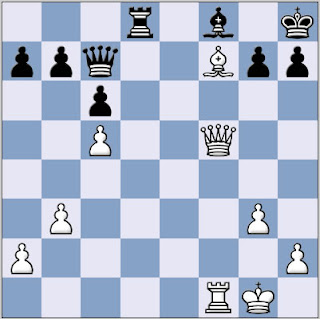
Richard Réti vs Efim Bogoljuboff, New York Chess 1924

Réti played 1 Be8 and Black resigned.

There is no satisfactory defence against the threat of 2 Qxf8, Even 1 ... h6 leads to immediate mate: 2 Qxf8+ Kh7; 3 Bg6+! Kxg6; 4 Qf5 mate

There were few correct solutions to the puzzles, although Brian Wood did suggest 1 ... Bf5 in the first position, which also leads to a very big advantage for Black.


The game against Bogojuboff is regarded as one of the greatest ever played, here it is in full with notes by Alekhine from the tournament book:

Richard Réti - Efim Bogoljubov, New York 1924

1.Nf3 d5 2.c4 e6

As for the merit of this system of defence, compare the game Reti vs. Yates in the
sixth round.

3.g3 Nf6 4.Bg2 Bd6 5.O-O O-O 6.b3 Re8 7.Bb2 Nbd7 8.d4

To our way of thinking, this is the clear positional refutation of 2...e6, which, by the way, was first played by Capablanca (as Black) against Marshall and is based upon the simple circumstance that Black cannot find a method for the effective development of his Queen's Bishop.

8 ... c6 9.Nbd2

In the game referred to, Capablanca, in a wholly analogous position, played ...Ne4 and likewise obtained an advantage thereby. Of course, Reti's quieter development is also quite good.

9 ... Ne4

If the liberating move of 9...e5, recommended by Rubinstein and others, is really the best here then it furnishes the most striking proof that Black's entire arrangement of his game was faulty. For the simple continuation 10.cxd5 cxd5 11.dxe5 Nxe5 12.Nxe5 Bxe5 13.Bxe5 Rxe5 14.Nc4 Re8 15.Ne3 Be6 16.Qd4, would have given White a direct attack against the isolated Queen's pawn, without permitting the opponent any chances whatsoever. Moreover, the move selected by Bogoljubow leads eventually to a double exchange of Knights, without moving the principal disadvantage of his position.

10.Nxe4 dxe4 11.Ne5 f5

Obviously forced.

12.f3

The proper strategy. After Black has weakened his position in the center, White forthwith must aim to change the closed game into an open one in order to make as much as possible out of that weakness.

12. ... exf3 13.Bxf3

Not 13.exf3, because the e pawn must be utilized as a battering ram.

13. ... Qc7

Also after 13...Nxe5 14.dxe5 Bc5+ 15.Kg2 Bd7 (after the exchange of Queens, this Bishop could not get out at all) 16.e4, White would have retained a decisive advantage in position.

14.Nxd7 Bxd7 15.e4 e5

Otherwise would follow 16.e5, to be followed by a break by means of d5 or g4. After the text move, however, Black appears to have surmounted the greater part of his early difficulty and it calls for exeptionally fine play on the part of White in order to make the hidden advantages of his position count so rapidly and convincingly.

16.c5 Bf8 17.Qc2

Attacking simultaneously both of Black's center pawns.

17. ... exd4

Black's sphere of action is circumscribed; for instance, 17...fxe4 clearly would not do on account of the two-fold threat against h7 and e5, after 18.Bxe4

18.exf5 Rad8

After 18...Re5 19.Qc4+ Kh8 20.f6, among other lines, would be very strong.

19.Bh5

The initial move in an exactly calculated, decisive manouver, the end of which will worthily crown White's model play.

19. ... Re5 20.Bxd4 Rxf5

If 20...Rd5 21.Qc4 Kh8 22.Bg4, with a pawn plus and a superior position.

21.Rxf5 Bxf5 22.Qxf5 Rxd4 23.Rf1 Rd8

Or 23...Qe7 24.Bf7+ Kh8 25.Bd5 Qf6 26.Qc8, etc. Black is left without any
defence.

24.Bf7+ Kh8 25.Be8

A sparkling conclusion! Black resigned, for, after 25...Bxc5+, he loses at least the Bishop.
Rightfully, this game was awarded the first brilliancy
prize. 1-0

Monday, 4 June 2007

Nimzo Indian Sämisch: a favourite idea

The Sämisch Variation of the Nimzo Indian gives rise to some spectacular attacking games. I've already talked about Euwe's brilliancy at Zurich 1953, and one of my wins from the Northumberland Quickplay Championships.

One of my best games with the variation was played in the Kent League back in 1995, where a Bronstein idea, pushing the f-pawn down the board, brought me a miniature victory against a strong opponent:

Roger Coathup - Colin Gentile (201 BCF, ~2260 FIDE), Kent League 1995

1 d4 Nf6; 2 c4 e6; 3 Nc3 Bb4; 4 a3 Bxc3+; 5 bc c5; 6 f3 0-0; 7 e4 d6; 8 Bd3 Nc6; 9 Nge2 Ne8; 10 0-0 b6; 11 f4 Na5;

Najdorf tried 11 ... Ba6 in this position in the 1950 Candidates against Bronstein but went down quickly to the same idea: 12 f5 e5; 13 f6 Kh8; 14 d5 Na5; 15 Ng3 gf; 16 Nf5 Bc8; 17 Qh5 Bxf5; 18 ef Rg8; 19 Rf3 Rg7; 20 Bh6 Rg8; 21 Rh3 1-0.

Black does better to play 11 ... f5 stalling White's f-pawn, after which the game takes on a completely different character.

12 f5 e5?!; 13 f6!

Nimzo Indian Saemisch Variation Coathup vs Gentile Chess


13 ... Nxf6?

After this Black is caught in a deadly pin on the half open f-file, and can't organise any reasonable king side defence. As we've seen in the Bronstein game, leaving the pawn on f6 also leaves Black in difficulty.

14 Bg5 Bg4

With Ne2-g3-h5 threatened, Black decides to exchange off the knight.

15 Qe1 Bxe2; 16 Bxe2 Re8; 17 d5 h6; 18 Bxf6 gf; 19 Qh4 Kg7; 20 Rf5 Rh8; 21 R1f1 Rc8; 22 Rxf6 Rc7; 23 Bh5 Rf8; 24 Bxf7 1-0

Wednesday, 2 May 2007

More Sämisch Tactics


Last week, we looked at Max Euwe's superb chess counterattack against Efim Geller. This game features yet more direct attacking in the Sämisch Variation of the Nimzo-Indian. This time though, it is White who comes out on top.

The game was played in a rapidplay tournament back in 1995. I sacrificed a bishop on h7 (in Greek Gift style) to rip open the Black king position, and the attack appears to flow smoothly from there.

The game also illustrates another theme, the need to look for every resource in a position. In this case, despite the seeming ferocity of the attack, Black missed a defence: after 23 Nh8 (awarded two exclamation marks in the newspaper column; pre-Fritz days) Black could have gained the advantage by 23 ... Be4! covering the h7 square and enticing the rook away from it's attacking station on h4. The correct way to have prosecuted the attack was 23 Re1 which is winning.

Roger Coathup - John Young, Northumberland Quickplay Championship 1995
1 d4 Nf6; 2 c4 e6; 3 Nc3 Bb4; 4 a3 Bxc3+; 5 bc c5; 6 f3 b6; 7 e4 0-0; 8 Bd3 Nc6; 9 Ne2 d6; 10 f4 Bb7; 11 0-0 Ne8; 12 f5 ef; 13 Rxf5 Rc8; 14 Bg5 Qd7; 15 e5 de; 16 de Na5; 17 Rf4 Qe6; 18 Bxh7+!! Kxh7; 19 Rh4+ Kg8; 20 Nf4 Qxe5; 21 Qh5 f6; 22 Ng6 Qc7; 23 Nh8? (23 Re1 wins) g6?; 24 Nxg6 Qg7; 25 Bh6 Qc7; 26 Nxf8 Ng7; 27 Rg4 1-0

Monday, 30 April 2007

Short's classic king march

Last week, I posted an inspired king march by Mikhail Tal. Today's game shows Nigel Short launching an incredible attack with his king in the midst of a ferocious middlegame battle with Jan Timman.

Here's what Nigel had to say to Chess Tales about this modern classic:

"I think I could have won with Nh4! (threatening Nxg6! and Rh4 at some moment) I didn't see it at all at the time: I think it was pointed out by Krasenkow (or maybe even his wife) later. Actually I was in quite a bit of time trouble. And yes, I did see the idea of K to h6 when I played Kh2.", Nigel Short

Nigel Short - Jan Timman, Tilburg 1991


1.e4 Nf6 2.e5 Nd5 3.d4 d6 4.Nf3 g6 5.Bc4 Nb6 6.Bb3 Bg7 7.Qe2 Nc6 8.O-O O-O 9.h3 a5 10.a4 dxe5 11.dxe5 Nd4 12.Nxd4 Qxd4 13.Re1 e6 14.Nd2 Nd5 15.Nf3 Qc5 16.Qe4 Qb4 17.Bc4 Nb6 18.b3 Nxc4 19.bxc4 Re8 20.Rd1 Qc5 21.Qh4 b6 22.Be3 Qc6 23.Bh6 Bh8 24.Rd8 Bb7 25.Rad1 Bg7 26.R8d7 Rf8 27.Bxg7 Kxg7 28.R1d4 Rae8 29.Qf6+ Kg8


This is where Nh4! would have been strong.


30.h4 h5


Short vs Timman Tilburg Chess 1991

And now Nigel treated us to his incredible king march:


31.Kh2!! Rc8 32.Kg3 Rce8 33.Kf4 Bc8 34.Kg5 1-0

Thursday, 26 April 2007

Nimzo Indian Sämisch Variation

Few openings are as direct and uncompromising as the Sämisch Variation of the Nimzo Indian, after

1 d4 Nf6; 2 c4 e6; 3 Nc3 Bb4; 4 a3 Bxc3+; 5 bc

White essentially has one idea in mind: I'm going to blast open lines for my rooks and diagonals for my bishops, and checkmate you on the king-side. White often carries out this plan at any cost.

Strategically, it's easy to learn and I've enjoyed playing it; Such direct attacking has notched me some notable scalps. Of course, there is a downside, a well organised defence can expose the lack of flexibility and positional weaknesses (notably the c4 pawn) in White's position.

Over the coming weeks, I'll show you a few games in this line (wins for both Black and White) and some of my own personal favourites. To start with though, let's go back to Zurich 1953, and the second round encounter between Efim Geller and former World Champion Dr. Max Euwe. This game was awarded a brilliancy prize. The notes are abridged from David Bronstein's in his excellent book of the tournament:

Geller - Euwe, Zurich 1953

White initiates a powerful attack on the king by sacrificing his c4-pawn. This attack gave Geller every hope of success, provided Black held to the traditional sort of queen-side counterattack. Euwe, however, carried out two remarkable ideas: 1. Utilizing his queen-side lines of communication for an attack on the king's wing. 2. decoying the enemy's forces deep into his own rear area, with the aim of cutting them off from the defence of their king.

Watch White's pieces in their frontal assault on the king, burrowing further and further, while Black is transferring his forces by roundabout routes.

1 d4 Nf6; 2 c4 e6; 3 Nc3 Bb4; 4 e3 c5; 5 a3 Bxc3+; 6 bc b6; 7 Bd3 Bb7; 8 f3 Nc6; 9 Ne2 0-0; 10 0-0 Na5; 11 e4 Ne8

Black retreats his knight to forestall the pin with 12 Bg5, and to be able to answer f3-f4 with f7-f5, blockading the king's wing. White therefore secures f5 before advancing his f-pawn. It would be senseless to defend the c4 pawn now: that pawn was doomed by White's 5th move.

12 Ng3 cd; 13 cd Rc8; 14 f4 Nxc4; 15 f5 f6; 16 Rf4

White's attack has become rather threatening. Black's previous move was necessary to forestall White's intention to push his pawn to f6, and then, after 16 ... Nxf6, to the pin the knight after all, piling up on the king with the combined firepower of queen, rooks and three minor pieces. Even now, White needs only two moves to transfer his rook and queen to the h-file, and then it might appear that nothing could save the Black king. (it's a wonderful feeling as White to be able to 'thump-down' f5-f6 in this variation, we'll see some games later where this happens - RC)

16 ... b5!

The beginning of a remarkable plan. Clearly, any defensive manouevres on the king-side are fore-doomed, since they involve pieces with an inconsequential radius of activity (.. Rf7, .. Qe7, etc.). But Black does have another defensive resource, and that is counterattack! The bishop at b7, the rook at c8, and the knight at c4 are all well based; all that remains is to bring up the queen. The basis for this counteratack is Black's preponderance on the central squares. With 16 ... b5, Black reinforces the knight on c4 and opens a path for the queen to b6. Still, one cannot help feeling that his operations are too little and too late...

17 Rh4 Qb6

Pinning White's queen to the defence of the d-pawn, Black prevents the intended 18 Qh5. After 17 Qh5 Qb6; 18 Ne2 Ne5, we get the echo variation with the rook unable to get to h4.

18 e5 Nxe5; 19 fe Nxd3; 20 Qxd3 Qxe6; 21 Qxh7+ Kf7; 22 Bh6 Rh8

If Black's 16th move was the beginning of his strategic plan of counterattack, then this rook sacrifice is it's fundamental tactical stroke, with the aim of drawing the White queen still further afield and decoying it from the c2, meanwhile attacking the king.

23 Qxh8 Rc2

Threatening mates in a few moves: 24 ... Rxg2+, 25 ... Qc4+, etc. Detailed analysis requiring more than just one week's time, showed that White could have saved himself from mate by finding a few 'only' and very difficult moves. First, he has to play 24 d5; if then 24 ... Qb6+; 25 Kh1 Qf2; 26 Rg1 Bxd5, White saves himself with 27 Re4!; and on the immediate 24 ... Bxd5, not 25 Rd4 - only 25 Rd1! works: after 25 ... Rxg2+; 26 Kf1 gh, neither 27 Rxh6 nor 27 Rxd5: once again, the only move is 27 Qxh6. Black would still have bishop and two pawns for his rook then, which would leave him good winning chances.

24 Rc1 Rxg2+; 25 Kf1 Qb3; 26 Ke1 Qf3 0-1


Tuesday, 24 April 2007

Marching the King

A King marching up a crowded chess board is a rare sight, but almost always the sign of a spectacular game. Most often, it is because the King has been driven up the board by the attacking pieces to be lured into a mating net, but occasionally the march is voluntary.

In this post, I've got an illustration of both. They are from two of the best games in chess history. The first sees Mikhail Tal strolling up the board, sacrificing two pawns in the process, to set up a winning ending. The second is a spectacular king hunt by Alexander Kotov; the most beautiful game played at the famous Zurich 1953 Candidates Tournament.

Tal vs Lissitzin, Instructive ChessThis is the postion after 24 moves in Tal vs. Lisitsin, Leningrad 1956 (Game no.2 in Chernev's "The Most Instructive Games of Chess Ever Played"). Tal has sacrificed a pawn to hem in Black's bishop and break up the kingside pawn structure, but Black is not without compensation: his rook is on the open file, his knight is preparing to invade and White's kingside pawns are potentially vulnerable. Tal, though, hit on an inspired idea to exploit Black's weaknesses: he marched his king up the board:

25 Kd2! Ng3; 26 Kc3 f4; 27 Kd4 Bf5; 28 Rd2 Re6; 29 Nc5 Rh6; 30 Ke5! Bxd3; 31 cd Rxh3; 32 Kd6 Rh3+; 33 Kc7

Tal vs Lissitzin, Instructive ChessIn just 8 moves Tal's king has gone from c1-c7 and he has sacrificed a second pawn. However, he now uses the active position of his king to force a won rook ending:

33 ... Nf5; 34 Kb7 Nd4; 35 Rf2 a5; 36 Rxf5 Ne6; 37 Rg4+ Kf8; 38 Kxc6 Nxc5+; 39 Kxc5 Re6; 40 Kxd5

Tal is clearly better in this rook ending; it's instructive to follow his technique in concluding the game:

40 ... Rb6; 41 b4 ab; 42 ab Ke7; 43 Kc5 Rf6; 44 Rd4 Rf5+; 45 Kb6 Rf6+; 46 Kc7 Rf5; 47 Re4+ Kf6; 48 Kc6 Rf2; 49 g4 h5; 50 gh Kg5; 51 b5 f5; 52 Rb4 f4; 53 b6 f3; 54 b7 1-0

The next game, Averbakh - Kotov Zurich 1953 was greeted with quotes such as "unique in chess literature" and "once in a hundred years". This is what Bronstein had to say about the position after White's 30th move:

Averbakh - Kotov, Zurich 1953 Candidates Chess Tournament
"The creative element of chess is generally thought to consist of three things: logic, accurate calculation, and technuique (this last includes a knowledge of theory). There is a fourth ingredient also, however, perhaps the most intriguing of all, although it is often overlooked. I refer to intuition - chess fantasy, if you prefer.

Occasionally a position arises in the course of a game which cannot be evaluated on general principles, such as pawn weaknesses, open lines, better development, etc., since the state of equilibrium has been upset on several counts, rendering an exact weighing of the elements impossible. Attempting to calculate the variations doesn't always work, either. Imagine that White has six or seven different continuations, and Black five or six replies to each move; it's easy to see that no genius on earth could reach even the fourth move in his calculations. It is then that intuition or fantasy comes to the rescue: that's what has given the art of ches its most beautiful combinations, and allowed chessplayers the chance to experience the joy of creating.

It is not true to say that intuitive games were only played in the days of Morphy, Anderssen and Chigorin (as if now, in our era, everything were to be based totally on positional principles and rigorous calculation!): I remain convinced that, even in the games which received the brilliancy prizes at this tournament, not all of the variations were calculated to the end. Intuition has been and remains one of the cornerstones of chess creativity - of which we shall now see proof positive." David Bronstein, International Chess Tournament: Zurich 1953

Kotov began a remarkable combination by sacrificing his queen:

30 ... Qxh3+; 31 Kxh3 Rh6+; 32 Kg4 Nf6+; 33 Kf5

Averbakh - Kotov, Zurich 1953 Candidates Chess TournamentThe king has been driven into the net of Black's remaining pieces, and now 33 ... Ng4! would have finished the game quickly. Although, after the move Kotov played, 33 ... Nd7, White despite his extra Queen was still unable to defend the position.

You can play through the full games Tal vs Lisitsin and Averbakh vs Kotov online.

Sunday, 22 April 2007

Thinking chess books

One of the Chess Tales' readers has asked me if I could recommend a list of "must-have" chess books. I've started thinking hard, but believe me it's not easy. For example, opening books pre-dominate in chess literature, but with so many openings out there, and everybody having their own favourites, it's difficult to make general recommendations. I've set myself a target though: a top 10 by next Sunday. Keep watching this space!

In the meantime, let me talk about a book that came out recently and has been fighting Kasparov's "Life Imitates Chess" toe-to-toe for the review column inches: "The King's of New York" by Michael Weinreb.

This is not your usual chess book, but more a chronicle of the lives, relationships, and ups and downs of a 'wrong side of the tracks' but highly successful school chess team. Edward R Murrow school is in Brooklyn, New York and draws its students from a diverse range of cultures; the chess team, coached by a former hockey professional, includes a Lithuanian and a Puerto Rican amongst others.

I have to admit I haven't read the book, but it would great to hear the thoughts of any Chess Tales' reader who has. Email me on roger AT 21thoughts DOT com.

You can also check out what the newspapers have been saying about the book, whose subtitle is "A year among the geeks, oddballs and geniuses who make up America's top high school chess team":

"Geeks, oddballs and geniuses", Daily Telegraph (UK) 19th April

"Mad hot chessboard", NY Times (US) 4th March

"Chess with God (and others)", The Guardian (UK) 21st April

"He was more fun in the pawn squad", The Guardian (UK) 22nd April

Wednesday, 18 April 2007

The Grünfeld Defence 2

Ernst Grunfeld, Chess Player

I posted earlier this month about the Grünfeld Defence, but given it's high popularity in Google searches that are used to discover the Chess Tales blog, I'm happy to write more.

In this post, I'll tell you about a Grünfeld line we prepared for the European Chess Championships; Sophie didn't get the opportunity to use it, but I've played it twice myself recently with success. I'll also point you to the literature that's available and show you a couple of sample games.

The Grünfeld has featured in the repertoires of World Champions: Kasparov, Fischer, Botvinnik and Smyslov. The great Viktor Korchnoi used it regularly. In the early 50's he copied out and analysed a hundred Grünfelds as part of his preparation for the final of the 20th USSR Championships. Reportedly, when Alekhine was first confronted with the defence he resigned the game by hurling his king across the room.

The Exchange variation (1 d4 Nf6; 2 c4 g6; 3 Nc3 d5; 4 cd Nxd5; 5 e4 Nxc3; 6 bc) is far and away the most common continuation, but amongst the 'sidelines', the Russian system (1 d4 Nf6; 2 c4 g6; 3 Nc3 d5; 4 Nf3 Bg7; 5 Qb3) remains interesting, leads to complex positions and has featured in high level encounters between Karpov and Kasparov, and famously between Botvinnik and Fischer at Varna in 1962 (see My 60 Memorable Games(Amazon)).

Earliest games in the opening (1922) were in the Exchange variation and went 6 ... Bg7; 7 Nf3. Eventually, White players started preferring a setup with 7 Bc4 and 8 Ne2, which gave rise to some interesting games where White sacrificed the exchange (rook on a1 for bishop on g7) and attacked the Black king, or got in an early Bxf7+ (which was played by Karpov in his Seville World Championship match with Kasparov). In the 80's though, there was a return to favour of 7 Nf3 (particularly in conjunction with 8 Rb1) and this became known as the Modern Exchange Variation.

The variation we prepared for the European Chess Championships is a refinement on the Modern Exchange Variation: Instead of 7 Nf3, White first plays Be3 and then Qd2 before finally developing the Knight to f3. It was adopted by Karpov in his 1990 match with Kasparov, and has sound strategic foundations. After the usual continuation 7 Be3 0-0; 8 Qd2 c5; 9 Nf3 we reach the following position:


By playing the moves in this order, White avoids a ... Bg4 pin by Black which serves two motives: firstly it reduces the pressure that Black can apply on White's centre, and secondly White can avoid any Bg4xf3 simplifications and aim to cramp Black's position. We'll see a radical illustration of this in one of our sample games, after the continuation 9 ... Bg4; 10 Ng5!?.

Depending how Black plays, White now has some clear ideas in this position. 9 ... Nc6 is met by 10 d5 establishing a very strong central pawn phalanx, and 9 ... Qa5; 10 Rc1 e6 (preparing Nc6) can be met directly by 11 Bh6! looking to exploit the holes on the dark squares. Finally, White can meet 9 ... Qa5; 10 Rc1 cd; 11 cd Qxd2 with 12 Nxd2 and hope for a better ending.

This approach is explored in depth in Beating the Indian Defences by Burgess and Pedersen. For those looking to play the Black side, I recommend taking a look at Rowson's Understanding the Grünfeld or The Grünfeld Defence by Nigel Davies. If you are looking a clear and simple guide to the concepts and variations there is Aagard's Starting out: The Grünfeld. For an incredibly detailed investigation of some key games, you can also try Karpov's Beating the Grunfeld (Amazon).


If you are looking to buy these books in the US you can try my Chess Online store.


Here's Karpov avoiding the Bishop exchange against Kasparov:
Anatoly Karpov - Garry Kasparov, 17th Game, World Championship, Lyon 1990

1.d4 Nf6 2.c4 g6 3.Nc3 d5 4.cxd5 Nxd5 5.e4 Nxc3 6.bxc3 Bg7 7.Be3 c5 8.Qd2 O-O 9.Nf3 Bg4 10.Ng5

This was Karpov's new move; this game is covered in depth in his "Beating the Grünfeld". I was delighted when I got the opportunity to play it at Edinburgh last weekend, but couldn't convert an ending a pawn up.

cxd4 11.cxd4 Nc6 12.h3 Bd7 13.Rb1 Rc8 14.Nf3 Na5 15.Bd3 Be6 16.O-O Bc4 17.Rfd1 b5 18.Bg5 a6 19.Rbc1 Bxd3 20.Rxc8 Qxc8 21.Qxd3 Re8 22.Rc1 Qb7 23.d5 Nc4 24.Nd2 Nxd2 25.Bxd2 Rc8 26.Rc6 Be5 27.Bc3 Bb8 28.Qd4 f6 29.Ba5 Bd6 30.Qc3 Re8 31.a3 Kg7 32.g3 Be5 33.Qc5 h5 34.Bc7 Ba1 35.Bf4 Qd7 36.Rc7 Qd8 37.d6 g5 38.d7 Rf8 39.Bd2 Be5 40.Rb7 1-0 (I seem to be publishing a lot of Kasparov's losses on Chess Tales; he won quite a few games as well! I'll try to correct things in the coming weeks)


And, here's Fischer's epic encounter with Botvinnik in the Russian System:
Mikhail Botvinnik - Bobby Fischer, Varna Olympiad 1962

1. c4 g6 2. d4 Nf6 3. Nc3 d5 4. Nf3 Bg7 5. Qb3 dxc4 6. Qxc4 O-O 7. e4 Bg4 8. Be3 Nfd7 9. Be2 Nc6 10. Rd1 Nb6 11. Qc5 Qd6 12. h3 Bxf3 13. gxf3 Rfd8 14. d5 Ne5 15. Nb5 Qf6 16. f4 Ned7 17. e5 Qxf4 18. Bxf4 Nxc5 19. Nxc7 Rac8 20. d6 exd6 21. exd6 Bxb2 22. O-O Nbd7 23. Rd5 b6 24. Bf3 Ne6 25. Nxe6 fxe6 26. Rd3 Nc5 27. Re3 e5 28. Bxe5 Bxe5 29. Rxe5 Rxd6 30. Re7 Rd7 31. Rxd7 Nxd7 32. Bg4 Rc7 33. Re1 Kf7 34. Kg2 Nc5 35. Re3 Re7 36. Rf3+ Kg7 37. Rc3 Re4 38. Bd1 Rd4 39. Bc2 Kf6 40. Kf3 Kg5 41. Kg3 Ne4+ 42. Bxe4 Rxe4 43. Ra3 Re7 44. Rf3 Rc7 45. a4 Rc5 46. Rf7 Ra5 47. Rxh7 Rxa4 48. h4+ Kf5 49. Rf7+ Ke5 50. Rg7 Ra1 51. Kf3 b5 52. h5 Ra3+ 53. Kg2 gxh5 54. Rg5+ Kd6 55. Rxb5 h4 56. f4 Kc6 57. Rb8 h3+ 58. Kh2 a5 59. f5 Kc7 60. Rb5 Kd6 61. f6 Ke6 62. Rb6+ Kf7 63. Ra6 Kg6 64. Rc6 a4 65. Ra6 Kf7 66. Rc6 Rd3 67. Ra6 a3 68. Kg1 1/2-1/2

If you want to know more about how I analyse Google (and other search engine) queries, see maps of the Chess Tales readers, and the mechanics of operating the blog, please let me know (either by comment or email to roger AT 21thoughts DOT com)and I'll give you the 'low-down'.

Tuesday, 17 April 2007

Chess in the Attic 1980: Tony Miles and the Dragon

Ljubojevic vs Tony Miles, Malta Chess Olympiad 1980, New Statesman ArticleI was up in the attic (again!) looking for an old chess scoresheet when I came across a treasure I thought was lost: a 1980 Tony Miles column from the New Statesman, "The Maltese Dragon".

The column gave a detailed analysis of his game with the Sicilian Dragon against Ljubomir Ljubojevic at the Malta Olympiad. I've wanted to blog about this article for a while. It made a huge impression on me at the time and has always stuck in my mind; I was delighted to discover I still had it.

As a schoolboy, I was amazed by the complexity of the game and of the host of variations that Miles seemed to glibly trot-out (in pre-Fritz days). It was a bit like being in the first year and seeing a sixth former's maths book full of calculus: "I'd never be able to do that". Actually, thinking back to my maths A-level grade perhaps I never was able to do that.

Without the Internet, getting hold of the latest chess games in 1980 was a treat. Miles's column in the New Stateman (a 'socialist' weekly that my enlightened Independent School took in the Library) and Michael Stean's column in the Observer were favourites.

Here are the basic moves in pgn. The game is excellent in itself, but for full effect you need to read Miles notes and commentary. Let me know if you'd like a large format scan.

Ljubomir Ljubojevic - Tony Miles, Malta 1980
1.e4 c5 2.Nf3 d6 3.d4 cxd4 4.Nxd4 Nf6 5.Nc3 g6 6.Be3 Bg7 7.f3 O-O 8.Qd2 Nc6 9.Bc4 Bd7 10.h4 Rc8 11.Bb3 h5 12.O-O-O Ne5 13.Bg5 Rc5 14.f4 Nc4 15.Qd3 b5 16.e5 Ng4 17.Ne4 Rc8 18.exd6 f6 19.Rhe1 exd6 20.Nxd6 Kh7 21.f5 Nxd6 22.fxg6 Kh8 23.Bf4 Ne5 24.Bxe5 fxe5 25.Nf3 e4 26.Qxd6 exf3 27.Re7 Bg4 28.Qe5 Qxd1+ 29.Kxd1 fxg2 30.Kd2 Rfd8+ 31.Bd5 Rxd5+ 0-1

You can also play through the game online.

Miles and Ljubojevic played some fantastic games, including another Dragon in 1986 to which Robert Byrne gave a tennis 'derived' commentary in the New York Times. They also hold the record for the longest number of moves a piece has been left en-prise. Unfortunately, Tony, England's first Grandmaster, died prematurely after some troubled years. Ljubomir, the "foremost player of risky moves" according to Jim Loy, now lives in Spain but keeps on attacking.

Team England at the European Chess Championships

Tigran Petrosian former World Chess Champion
Team England didn't have the most successful time at the European Chess Championships, although some players did manage positive rating performances, including Jovanka Houska who made a strong 7 out of 11 in the women's event. Peter Sowray has written a comprehensive report on the English Chess Federation website.

Peter deserves special mention for not only 'managing' the team and reporting each day, but also for gaining the most rating points (over 18) by an english player at the championships, and for being very supportive of Sophie and the Chess Tales blog. Peter and I have met once over the board at the Isle of Man Tournament. I caught him in a 'standard' Sicilian Kan trap, winning a pawn and the better position out of the opening, but then had to scramble for a draw as he whipped up a dangerous initiative.

Young IM Stephen Gordon recovered well from a slow start, but unfortunately lost his final round game to the Armenian Grandmaster Tigran Petrosian. Stephen's rating has climbed at lightening pace to 2490; we played at Scarborough just 3 or 4 years ago when he was still rated in the 180's BCF (about 2100 FIDE). In that game, I played the King's Indian Defence and Stephen 'surprisingly' exchanged his bishop on e3 for my knight on c5 (the dark squared bishop is usually a piece White likes to keep hold of in the King's Indian Defence). However, his decision was sound and quickly led to a decisive position for White.

Unfortunately, I can't find the game score, so instead let me show you one of the most famous King's Indian games ever played and the other Tigran Petrosian (the former World Champion) also voluntarily parting with his dark squared bishop. It's from the Interzonal Tournament at Stockholm in 1962, and played in the 20th round! Petrosian finished 3rd, 2.5 points behind Fischer, but went on to win the controversial Candidates tournament in Curacao and then take the World Title from Botvinnik. In the game, Petrosian gives up both bishops for knights, but gains a total positional bind.

Sunday, 15 April 2007

Edinburgh Chess Congress: final day


My final day at the Edinburgh Chess Congress didn't go according to plan. In the morning I had been defending all game as Black against David Findlay (FIDE 2231), when we reached the position above. Best now is probably to play 18 ... Bxc5 19 Nxc5 Ng6; 20 Nxb7 Qxg3 and attempt to hold the ending with a pawn for the exchange down. Instead I saw the opportunity to try for more, and risked 18 ... Qb6. But, after the follow up 19 c3 Nxc5; 20 Qxe5 f6 can you work out how White forced a decisive material advantage?

In the afternoon, I played the opening horribly, but managed to hold the material level and scramble a draw. Overnight leader FM Richard Jones was held to a draw on Sunday morning, and looked to be in trouble in the afternoon when I left.

Thursday, 12 April 2007

Greatest woman chess player of all time?

Zsofia Polgar beautiful chess player

One of the good things about Google Analytics is that you can see the search queries people used to get to Chess Tales. My first post was based on one of these queries and so is today's: Who is the greatest woman chess player of all time?

Unlike the men's game this is a ratings 'no-brainer', in which Judit Polgar stands head, shoulders and probably upper torso above the chasing pack. But, that's not to say there aren't other women players who in their day have dominated the game and deserve special mention.

In the pre-war years, Vera Menchik was unstoppable, and perhaps in terms of achievement deserves to be called the greatest; She won the Women's world Title in 1927 and successfully defended it on 6 further occasions. Her career included victories over Samuel Reshevsky, Jacques Mieses and Dr. Max Euwe. Tragically, she was killed in 1944, at just 38 years of age, by a V-2 bomb.

Georgian, Nona Gaprindashvili, was the first woman to be awarded the Grandmaster title. She won the world crown in 1962 and was champion for the next 16 years. Her tournament victories included the Hasting Challengers 1963/64 and the Lone Pine Open in 1997.

Gaprindashvili was succeeded by another Georgian, 17 year old Maia Chiburdanidze who held the world title until the arrival of a number of great chinese players, including Xie Jun who took her title in 1991.

Since then though, it has been the era of the Polgar's. Eldest sister Susan won the world title, middle sister Sofia became an International Master and scored one of the best Open tournament victories of all time when just 14 years of age (8.5 out of 9 at Rome in 1989), whilst youngest sister Judit is simply phenomenal: famed for her attacking chess, she has broken the 2700 FIDE boundary, reached the top 10 in the world, and includes Garry Kasparov amongst her scalps:


Very few other women hold the Grandmaster title: Pia Cramling of Sweden has been strong for many years, Alexander Kosteniuk who continues to improve, Zhu Chen from China, Antoneata Stefanova from Bulgaria, and Humpy Koneru from India.

One to keep an eye on for the future is the remarkable You Hifan, only 12 years old, but rated over 2500.

Presentation

Chess Tales uses Picasa, part of Google Pack, for photos and images:

Find a sponsor for your web site. Get paid for your great content. shareasale.com.

Creative Commons License
Chess Tales by Roger Coathup: A collection of online articles about chess and chess players.